
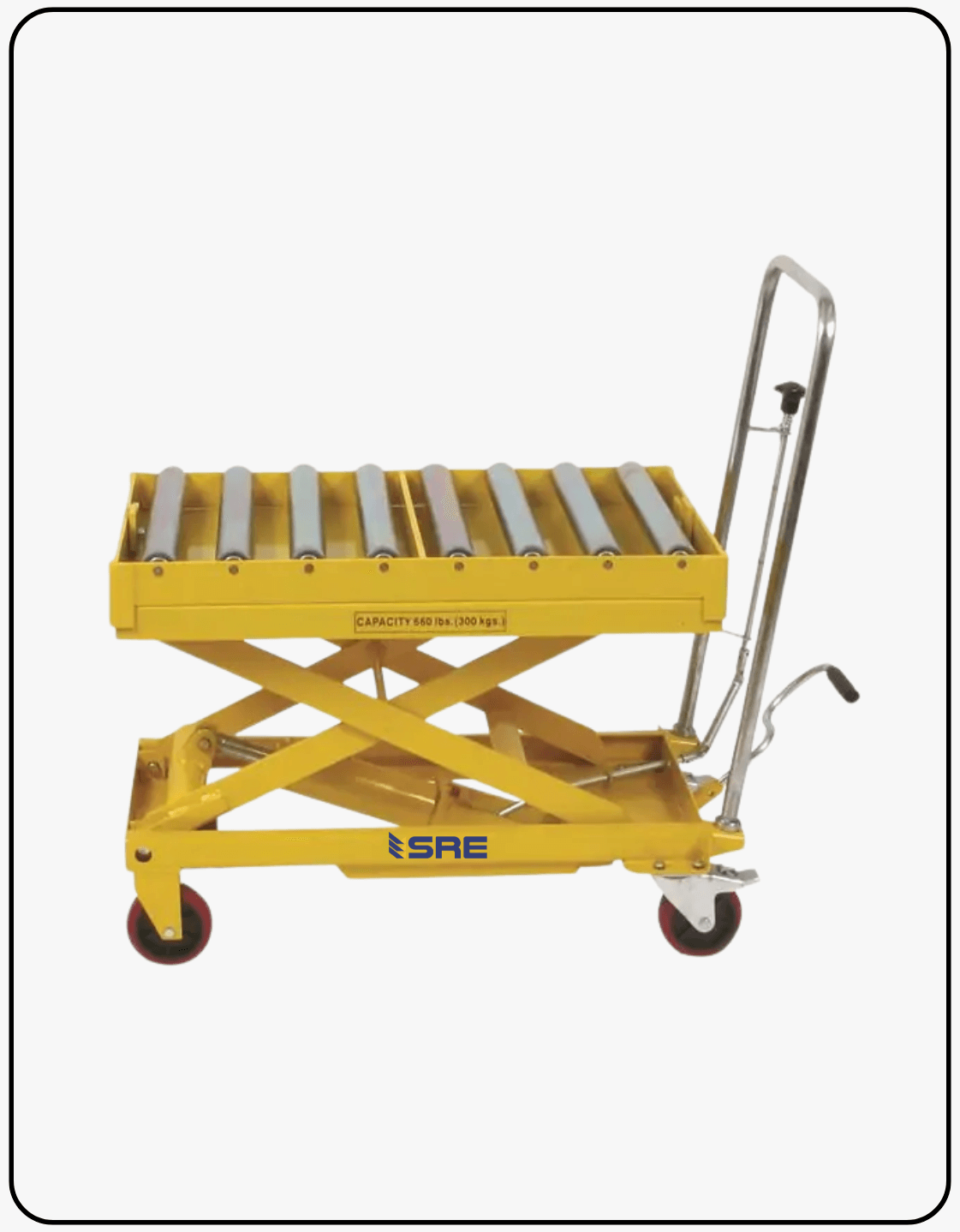
SRE Material Handling Equipment Pvt. Ltd.: Manufacturer, Supplier, And Exporter Of Roller Scissor Lift Table in India.
SRE Material Handling Equipment Pvt. Ltd., Manufacturer And Supplier Of Roller Scissor Lift Table in Rajkot.
Our Manufacturing Unit is in Ahmedabad, Vadodara, and Rajkot, Gujarat, India.
Roller Scissor Lift Table in Rajkot: A Useful Manual for Industry Leaders
In the past decade, industrial and storage facility activities have undergone significant changes. The surge in online shopping, strict delivery schedules, and the growing variety of products has driven the need for faster, safer, and more reliable internal material movement. In routine warehouse tasks, repeated lifting, manual product shifting, and inefficient material-handling practices introduce slowdowns that hinder operations and increase workplace accidents.
For those making industrial decisions—warehouse proprietors, factory supervisors, operations heads, supply-chain executives, and purchasing departments—the move from manual to mechanised internal handling is more than just a trend. It’s a direct reply to actual issues: increasing volume, output targets, staff tiredness, and safety regulations. Amidst this development, the Roller Scissor Lift Table in Rajkot emerges as a sensible answer that bridges the gap between human effort and operational needs.
The Evolving Requirements of Today’s Warehouses & Factories
Recent years have seen rising pressure on storage and manufacturing activities. Regardless of whether you manage a distribution hub near Rajkot or a production floor serving just-in-time providers, the shared constant is speed.
Operational Demands in Daily Processing
In day-to-day functions, your teams manage hundreds—sometimes thousands—of pallets, boxes, and parts each shift. These movements often involve:
- Raising and lowering items from assembly lines to storage shelves.
- Placing incoming raw materials at assembly points.
- Repetitive handling during order fulfilment and packaging.
- Moving completed goods to shipping zones.
Without appropriate material-handling equipment, these jobs rely heavily on manual labour or inadequate tools. This results in heightened fatigue, greater accident rates, uneven task execution, and unpredictable Output.
In this context, Roller Scissor Lift Tables are becoming necessary. They are not novelties; they are instruments grounded in practical industry requirements—improving Output, safeguarding personnel, and enabling smoother operational flows.
What Exactly Is a Roller Scissor Lift Table?
Fundamentally, a Roller Scissor Lift Table is a mechanical platform designed to elevate or lower heavy cargo, featuring integrated rollers on its top surface. Unlike typical lift tables, which provide only up-and-down movement, the roller version allows goods to move horizontally across the table’s surface.
Practically speaking, this means:
- Pallets and units can be moved onto and off the table with minimal exertion.
- Staff do not have to drag items by hand or reposition load-carrying tools.
- The table functions as a transitional work surface connecting conveyors, forklifts, and packing stations.
It’s worth noting that this is not a complex industrial robot or an overly intricate system. Instead, it is a straightforward, dependable apparatus engineered for actual industrial processes—especially where heavy loads and continuous use meet.
Why Roller Scissor Lift Tables Are Replacing Older Methods
Conventional material handling approaches in many storage facilities still rely on:
- Manual lifting by operators.
- Simple hydraulic or mechanical lift tables without transfer capabilities.
- Frequent handling using pallet jacks and forklifts in tight areas.
Each method has drawbacks:
- Manual lifting depletes workers’ energy and increases the risk of injury.
- Basic lift tables allow vertical motion but need separate transfer instruments.
- Forklifts excel at mobility but are inefficient for close-range workstations and detailed placement.
In day-to-day service, Roller Scissor Lift Tables fill these gaps by reducing physical strain and improving uniformity in repetitive tasks.
From Exhaustion to Uniformity
In a busy packing zone, staff often need to adjust goods up or down several times per hour. A standard table necessitates operators to adjust items or use secondary aids manually. With built-in rollers:
- Loads move easily onto or off the platform.
- Operators spend more time on processing and less time struggling with heavy objects.
- Worker fatigue—a leading cause of errors and downtime—is substantially cut.
This is not about replacing staff. It is about supplying them with implements that reduce physical stress and enhance task consistency.
Productivity Gains in Daily Operations
Putting in a Roller Scissor Lift Table in Rajkot affects Output in quantifiable ways. Across shifts, teams benefit from faster load transitions, fewer stoppages, and smoother handoffs between process steps.
Time Saved = Output Gained
Consider a typical setup where pallets arrive on one side of the line and must be prepared for unpacking or assembly. Without rollers, workers:
- Guide pallets by hand or with a jack.
- Align them with the workspace.
- Raise them to the needed height.
- Repeat for every unit.
With a Roller Scissor Lift Table:
- Pallets rest on the rollers.
- Operators adjust height with little effort.
- Items roll into the perfect position for processing.
This simple enhancement removes repetitive manual positioning, saving valuable moments per load and reducing cumulative fatigue over a shift.
Over the course of a day, these small gains yield:
- Greater Output per employee.
- Better consistency between shifts.
- Less dependency on overtime to meet deadlines.
Enhanced Workplace Safety
Industrial safety is mandatory—not just for rules but for staff morale and operational strength. In practical warehouse terms, accidents frequently result from:
- Overexertion during lifting.
- Slips or tumbles while moving cargo.
- Unnatural postures when arranging products.
Roller Scissor Lift Tables directly mitigate these risks by:
- Offering ergonomic height adjustment suitable for individual operators.
- Removing the need for manual sliding or repositioning of goods.
- Supplying a steady, regulated platform for load management.
In standard routines, this translates to fewer strain-related incidents and smoother, safer operational flows. While no machine replaces safe work habits, the right equipment continuously supports them.
Handling Heavier Goods More Easily
Modern storage facilities manage heavier, bulkier, and more diverse merchandise. Old handling methods struggle as piece weights climb or as frequent repositioning becomes necessary.
Roller Scissor Lift Tables are built to manage demanding payloads with stability and control. Core practical advantages include:
- Steady load-bearing: The scissor structure balances weight distribution, reducing the risk of tipping.
- Smooth transfer: Integrated rollers let heavier items glide with minimum force, reducing strain.
- Controlled lift/lower travel: Operators can place goods exactly at the required work heights without manual tweaking.
In actual warehouse settings—from staging incoming materials to moving finalised goods for shipping—handling heavier cargo safely and effectively offers a competitive edge.
Technology & Operational Performance
While it’s tempting to focus on technical details, industry leaders prioritise uptime, reliability, and ease of use most.
Modern Roller Scissor Lift Tables frequently include:
- Dependable power sources: Electric or hydraulic actuation built for steady, multi-shift operation.
- Designs needing minimal upkeep: Accessible parts for routine lubrication and maintenance.
- Safety lockdowns: Preventing accidental movement during load transfer.
These aren’t flashy features; they are practical components that support continuous operations. When your equipment fails, output halts. Investing in proven, reliable lift tables ensures essential internal logistics continue without sudden interruptions or costly repair calls.
Space Efficiency & Agility
Warehouse floor space is valuable. This is especially true for operations near Rajkot, where facilities may be constrained by layout or expansion limitations.
The Roller Scissor Lift Table’s compact size and built-in roller surface mean:
- It fits into narrower aisles or between workstations.
- There is no need for separate transfer conveyors or extra floor area for staging.
- Load movements are more predictable and rapid.
In day-to-day use, this spatial efficiency reduces crowding and improves movement throughout your warehouse or production zone.
Cost Effectiveness Over Time
When assessing material handling gear, cost is not limited to the initial purchase price. Long-term operational worth is more significant.
Real Cost Factors
Instead of concentrating only on initial outlay, effective assessment covers:
- Lower injury expenses: Fewer strain incidents mean reduced insurance claims and sick days.
- Efficiency gains: Faster handling and reduced delays boost Output.
- Staff retention: Ergonomic support helps retain experienced team members.
A Roller Scissor Lift Table delivers value by reducing hidden expenses and supporting steady performance over years of use.
Sustainability & Adherence
Sustainability is not merely a popular phrase—it is an operational philosophy. Whether driven by rules or corporate duty, cleaner, safer, and more energy-conscious operations are anticipated.
Roller Scissor Lift Tables aid sustainability objectives by:
- Minimising waste through fewer injury-related halts.
- Supporting energy-efficient systems, particularly electric actuation models.
- Helping maintain safer work settings that comply with legal requirements.
For factories and warehouses focused on environmental, social, and governance (ESG) targets, this alignment is essential.
Fitting into Warehouse / Factory Processes
Equipment only generates true worth when it integrates with current workflows. Roller Scissor Lift Tables are flexible and blend well with:
- Conveyor setups.
- Packaging and sorting stations.
- Assembly production lines.
- Loading/unloading bays.
Trending F&A
Q1: How does a Roller Scissor Lift Table improve safety compared to manual lifting?
A: It reduces repetitive strain by providing ergonomic height adjustment and eliminates manual repositioning of heavy loads.
Q2: Can the Roller Scissor Lift Table be integrated with conveyors?
A: Yes, its design supports seamless integration with conveyor lines for smoother load transitions.
Q3: What maintenance does a Roller Scissor Lift Table require?
A: Basic preventive maintenance includes regular lubrication of mechanical joints and periodic inspection of rollers and actuation systems.
Contact us today for Roller Scissor Lift Table solutions. Call +91 9316 208879 or sremhepvtltd2025@gmail.com for assistance now.
#RollerScissorLiftTable #WarehouseEfficiency #MaterialHandling #IndustrialOperations #SREMaterialHandlingEquipmentPrivateLimited #RajkotIndustry #SupplyChainSolutions #WorkplaceSafety