
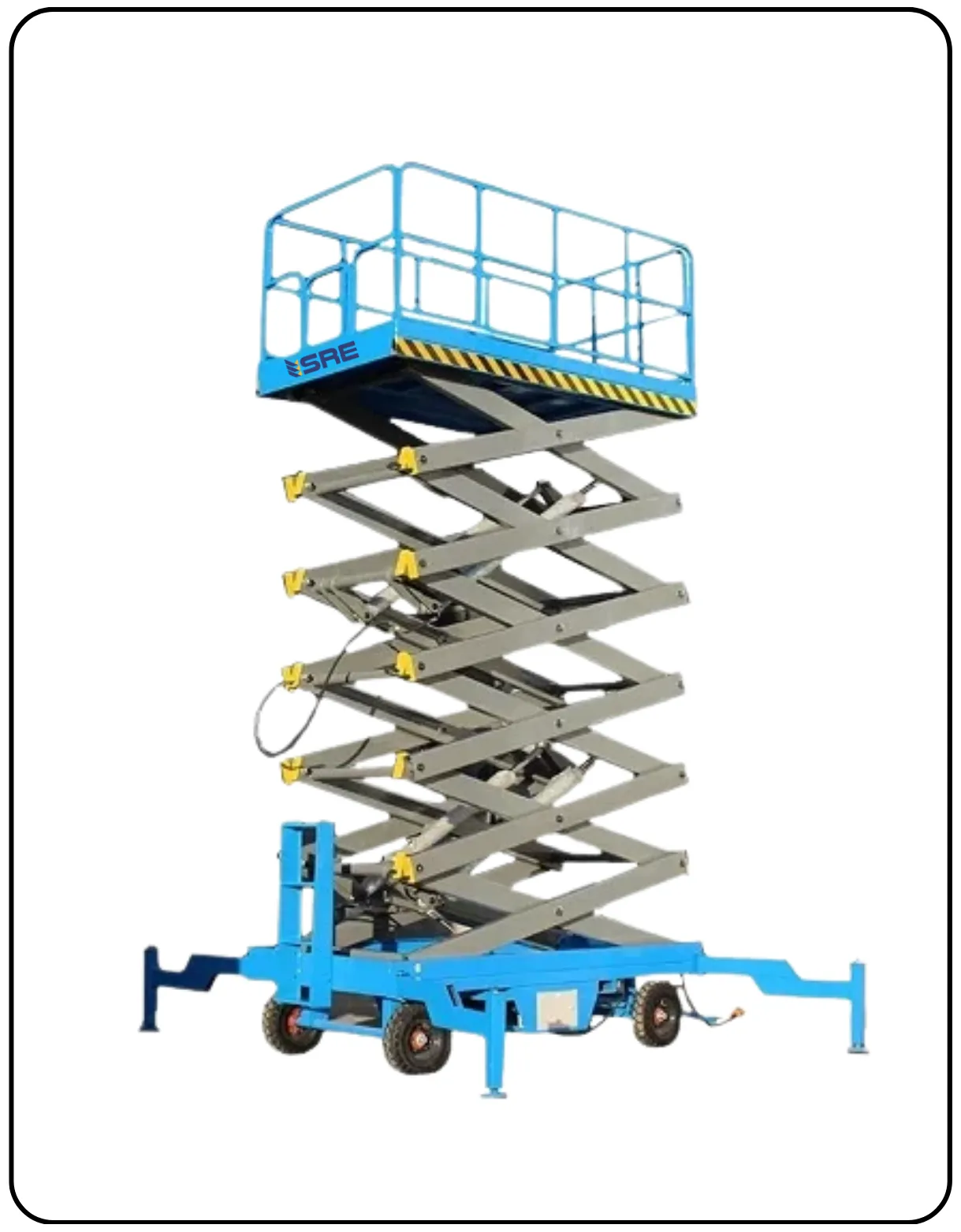
SRE Material Handling Equipment Pvt. Ltd.: Manufacturer, Supplier, And Exporter Of Scissor Lift Table in India.
SRE Material Handling Equipment Pvt. Ltd., Manufacturer And Supplier Of Scissor Lift Table in Chakan.
Our Manufacturing Unit is in Ahmedabad, Vadodara, and Rajkot, Gujarat, India.
Scissor Lift Table in Chakan: A Sensible Answer for Contemporary Industrial Workflows
Introduction
Industrial activities in and around Chakan have evolved considerably over the last ten years. Warehouses and production facilities are managing greater volumes, stricter dispatch timelines, and higher safety standards than ever before. What previously sufficed with manual carrying or basic elevation gear now frequently becomes a constraint.
In typical warehouse operations, common hurdles include repeated lifting, inconsistent work heights, staff exhaustion, and heightened hazard exposure—these concerns directly affect output, safety records, and staff morale.
This situation presents a Scissor Lift Table as a sensible, down-to-earth remedy. Instead of being a specialty or complex apparatus, it addresses a fundamental requirement—securely raising goods and placing them at an ergonomic operating level.
The Evolving Requirements of Current Warehouses & Sectors
Chakan has become a significant production and distribution centre, supporting automotive, engineering, and consumer goods, as well as supplier networks. This expansion brings operational strain.
Today’s warehouses face:
- Quicker entry and exit of merchandise
- Multi-shift schedules with constant output expectations
- Restricted floor area despite growing stock
- Scarcity of skilled personnel and increased reliance on machinery
In actual operations, slowdowns frequently occur at receiving docks, assembly points, and packaging zones—not due to a lack of staff, but because of inefficient material transport at ground level.
Contemporary methods demand equipment that supports personnel rather than drains them.
What Is a Scissor Lift Table?
A Scissor Lift Table is an elevating platform that raises items vertically using a mechanism resembling scissors. Practically speaking, it enables materials to be lifted smoothly from the floor surface to a comfortable operational elevation.
Unlike pallet jacks or overhead hoists, it doesn’t transport materials across lengthy distances. Its function is precise placement—lifting, holding, and lowering items right where the work takes place.
In factories and storage areas, it’s frequently employed at:
- Assembly lines
- Packaging and inspection stations
- Loading and offloading bays
- Maintenance and tool management zones
Why Scissor Lift Table Is Superseding Older Manual Gear
Previous techniques, such as hand carrying, timber pallets, or fixed-height platforms, were adequate when volumes were modest. Now, they generate more problems than they resolve.
Manual handling results in:
- Deterioration across shifts
- Variable work speed
- Increased accident likelihood
- Reliance on physical capacity
A Scissor Lift Table substitutes uncertainty with command. Operators alter the height according to task demands, not physical strain. This uniformity is vital in high-throughput settings where even minor inefficiencies compound.
Output Enhancements in Routine Tasks
In daily warehouse functions, output often diminishes through small, repeated actions—bending, lifting, adjusting, and repositioning loads.
Utilising a Scissor Lift Table:
- Decreases the time spent adapting to work elevation
- Keeps materials readily accessible
- Maintains steady output across work periods
When staff are not physically taxed, productivity remains steadier. Over time, this fosters smoother workflows rather than sudden lulls caused by fatigue.
Better Workplace Security
A single major event seldom causes workplace incidents. Most arise from recurring poor stances and uncontrolled lifting motions.
A Scissor Lift Table promotes safer working by:
- Ensuring load steadiness during elevation
- Minimising stooping and twisting
- Allowing regulated vertical transit
From a safety supervisor’s viewpoint, this directly contributes to reduced bodily ailments and fewer reported incidents.
Moving Heavier Goods Effortlessly
As production expands, load weights increase. Managing these loads manually or with makeshift methods increases risk.
Scissor Lift Tables are engineered for:
- Uniform load distribution
- Stable lifting under weight
- Predictable motion without sudden jolts
This stability is crucial when handling components, machinery, or boxed items that must remain undamaged during transport.
Technology & Work Process Effectiveness
Modern Scissor Lift Tables employ dependable hydraulic or electro-hydraulic systems built for continuous industrial use.
From a functional perspective, this signifies:
- Low energy usage
- Reliable lifting cycles
- Infrequent breakdowns with scheduled upkeep
For operations managers, dependability is more crucial than advanced capabilities. Equipment that operates every shift without downtime delivers tangible efficiency gains.
Space Maximisation & Ease of Movement
Floor area within Chakan storage facilities is precious. Clumsy machinery obstructing pathways creates crowding.
Scissor Lift Tables are compact and:
- Fit into existing work areas
- Function well in tight spots
- Don’t necessitate large turning ranges
This permits superior area planning without necessitating complete layout overhauls.
Value Over the Long Haul
While the upfront acquisition expense receives much attention, the actual value emerges over the years of service.
Benefits realised over time comprise:
- Less interruption from staff injuries
- Decreased worker exhaustion and staff churn
- Minimised harm to product stock
- Fewer breaks in the operational sequence
As time passes, these cost reductions surpass the preliminary outlay, particularly in continuous operation settings.
Eco-Friendliness & Regulatory Adherence
Current manufacturing processes increasingly emphasise compliance with regulations and environmental responsibility.
Scissor Lift Tables aid this effort by:
- Cutting down on needless power consumption
- Facilitating quieter, cleaner work environments
- Helping meet ergonomic standards
This syncs effectively with internal reviews and external compliance mandates.
Blending with Plant / Warehouse Flow
A Scissor Lift Table doesn’t substitute existing setups—it enhances them.
It connects smoothly with:
- Material transport lines
- Production assembly sequences
- Packaging zones
- Manual or partially automated processes
This adaptability permits gradual adoption without disrupting current work.
Simplicity of Operation, Servicing, and Staff Preparation
Ease of use stands out as a significant plus. Most personnel need very little instruction to utilise a Scissor Lift Table safely.
Upkeep is uncomplicated:
- Routine checks
- Basic fluid system reviews
- Predictable service schedules
This keeps equipment idle time low and scheduling straightforward.
The Importance of Selecting a Dependable Producer
The longevity of Scissor Lift Tables varies significantly by maker. Build quality, adherence to safety norms, and post-sale assistance create a real difference.
A trusted manufacturer guarantees:
- Uniform performance levels
- Adherence to industry benchmarks
- Availability of support services and replacement components
Firms such as SRE MATERIAL HANDLING EQUIPMENT PRIVATE LIMITED concentrate on functional industrial answers customised for Indian operational settings.
Final Thoughts
In dynamic factory settings like Chakan, operational effectiveness hinges on minor yet impactful upgrades. A Scissor Lift Table represents one such enhancement addressing output, safety, and workforce longevity simultaneously.
For production halls and storage facilities seeking to streamline procedures without overly complex installations, it remains a pragmatic and proven choice.
A thoughtful assessment based on actual operational necessities—rather than just specifications—will invariably yield better outcomes.
Key Takeaways
- Output: Supports steady production across all shifts
- Well-being: Cuts down on injuries related to manual lifting
- Load Management: Improves stability for heavier items
- Fiscal Benefit: Provides long-term operational savings
- Industry Alignment: Fits well with modern facility practices
Trending FAQs (F&Q)
Q1. Is a Scissor Lift Table suitable for continuous industrial use?
Yes, when designed for industrial duty cycles, it performs reliably across multiple shifts.
Q2. Can it be customised for specific load capacities?
Most manufacturers offer customisation of capacity and platform size based on operational needs.
Q3. How much maintenance does a Scissor Lift Table require?
Routine inspections and scheduled servicing are usually sufficient.
Q4. Is operator training complicated?
No. Basic operational and safety training is generally enough.
Q5. Does it fit into existing warehouse layouts?
Its compact design allows easy integration without significant layout changes.
Talk to our team today for reliable material handling solutions. Call +91 75728 19958 or sremhepvtltd2025@gmail.com for assistance now.
#ScissorLiftTable #MaterialHandling #WarehouseSolutions #IndustrialEquipment #FactoryEfficiency #ChakanIndustries #SREMaterialHandling