
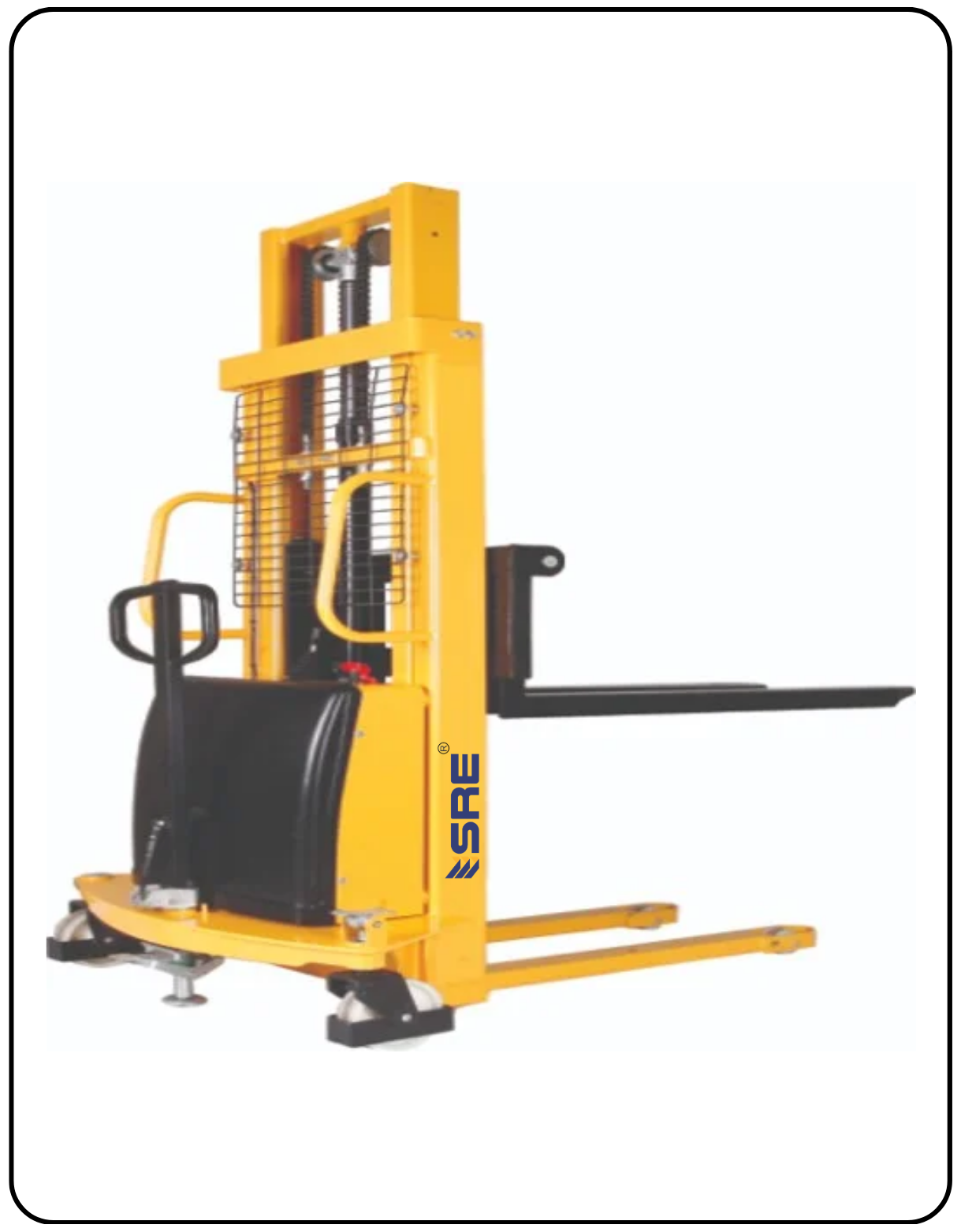
Semi Battery Stacker in Ahmedabad – Applications, Key Features & What Warehouse Managers Need to Know Before Buying
In warehouses and factory floors across Ahmedabad, Vadodara, and Pune, the shift from manual stackers to powered equipment isn’t a luxury decision anymore — it’s a throughput necessity. When your team is lifting 1,000 kg loads to 3-metre rack heights repeatedly across an 8-hour shift, manual pump fatigue becomes a measurable operational cost. Workers slow down, stacking accuracy drops, and injury risk climbs. The Semi Battery Stacker in Ahmedabad from SRE Material Handling Equipment Pvt. Ltd. solves exactly this: electric-powered lifting through a 24V/150Ah maintenance-free battery does the vertical work automatically, while the operator continues to steer manually — giving you the efficiency of a powered stacker without the full cost and complexity of a ride-on forklift. This design handles capacities from 1 ton to 2 ton and lift heights up to 3.5 metres, covering the practical needs of 90% of racked warehouse operations in Gujarat, Maharashtra, and Rajasthan.
“A textile export firm in Ahmedabad’s Narol industrial area was running manual stackers for 2-ton cotton bale pallets. Operators were pumping 60 to 80 lifts per shift and filing fatigue complaints by week three. We deployed four units of our SRE Semi Battery Stackers — electric lift, manual drive. Fatigue complaints dropped to zero. Stacking cycle time reduced by 38%. That’s a real, measurable outcome, not a sales pitch.”
— Senior Application Engineer, SRE Material Handling Equipment Pvt. Ltd., Ahmedabad, GujaratApplications of Semi Battery Stacker Across Industrial Sectors in Ahmedabad, Gujarat, and Pune
The operational sweet spot for a semi-electric stacker sits between a manual stacker and a full battery-electric rider stacker. Plant managers in Ahmedabad, Kalol, and Himmatnagar who run medium-density racking systems — typically 2.5 metres to 3.5 metres high — find that a manual stacker causes operator fatigue by shift midpoint, while a full electric rider stacker is over-specified and hard to manoeuvre in aisles below 2 metres wide. The semi-battery stacker hits that middle ground precisely: the electric motor handles the lift, the operator handles direction and positioning, and the aisle requirement stays at 1,500 mm — making it viable in most standard Indian warehouse racking layouts across Gujarat, Maharashtra, and Rajasthan.
Industry-Wise Application Areas
- FMCG & Retail Distribution (Ahmedabad, Vadodara, Indore): Stacking carton pallets to 3-metre rack heights in high-cycle distribution centres — typically 80 to 120 stack-and-retrieve operations per shift per operator, which a semi-battery unit handles without efficiency degradation.
- Pharma & Healthcare Warehousing (Ahmedabad, Hyderabad, Bangalore): Placing temperature-sensitive drug pallets at defined rack positions in GDP-compliant cold-chain warehouses where consistent positioning accuracy within ±10 mm is critical.
- Automotive Component Storage (Pune, Faridabad, Gurugram): Stacking heavy pressed-part trays and sub-assembly bins weighing 800 kg to 1,500 kg at multi-level racking positions on shop floors with 1.8-metre aisle widths.
- Textile & Apparel (Ahmedabad, Surat, Bhavnagar): Lifting baled fabric rolls and finished garment cartons to overhead rack levels across narrow-aisle fashion logistics warehouses where precision matters as much as speed.
- E-Commerce Fulfilment (Noida, Chennai, Hyderabad): High-frequency put-away and retrieval operations in 24×7 fulfilment centres where battery-powered lift eliminates manual fatigue across rotating shift teams.
- Cold Storage & Food Processing (Gujarat, Maharashtra, Rajasthan): Operating in 2°C to 8°C refrigerated environments where battery-powered electric lift (no manual pump effort) keeps operators comfortable and productive across entire shifts.
- Engineering & Heavy Manufacturing (Ahmedabad, Kutch, Ghandhidham): Handling tooling pallets, die carts, and component trays up to 2 tons at multi-tier shelving in large-footprint production shops with overhead clearance of 4 metres or more.
- Logistics & 3PL Hubs (Ahmedabad, Pune, Bangalore, Chennai): Cross-dock staging and racked storage operations where mixed pallet weights require flexible lift capacity and minimal operator retraining time across contract workforce teams.
What makes the semi-electric stacker particularly well-suited to Indian industrial conditions is its hybrid control model. In facilities in Bhopal, Rohtak, and Ambala where power supply stability is variable, a semi-battery unit with a reliable 24V lead-acid or lithium battery providing 6 to 8 hours of continuous lift operation on a single charge gives operations teams consistent daily performance without dependence on uninterrupted mains power. That operational reliability — per shift, per operator, per rack row — is what purchase heads in Jaipur and Udaipur consistently cite as their primary reason for choosing semi-electric over purely manual configurations.
Key Technical Features of SRE Semi Battery Stacker — What Plant Managers in Ahmedabad, Noida, and Bangalore Must Verify Before Purchase
Too many procurement teams in Noida, Faridabad, and Bangalore focus exclusively on sticker price when sourcing a semi-electric stacker — only to discover 4 months into operation that the battery degrades rapidly under three-shift use, the mast deflects at full height extension, or the charger doesn’t support fast top-up cycles. These are not minor inconveniences; they translate directly to production standstills and unbudgeted maintenance costs. The SRE Semi Battery Stacker is built with a high-tensile MS steel mast with a structural tolerance of ±0.5 mm across the full lift stroke, a 24V / 150Ah maintenance-free VRLA battery rated for 1,200 charge cycles at 80% depth of discharge, and an AC-powered onboard charger compatible with standard 230V single-phase Indian grid supply — all verified under ISO 9001:2015 manufacturing protocols.
Full Technical Specifications — SRE Semi Battery Stacker
| Specification | SRE 1T / 1.6M (Standard) | SRE 1.5T / 3M | SRE 2T / 3.5M (Heavy Duty) |
|---|---|---|---|
| Load Capacity | 1,000 kg (1 Ton) | 1,500 kg (1.5 Ton) | 2,000 kg (2 Ton) |
| Lift Height (Max) | 1,600 mm | 3,000 mm | 3,500 mm |
| Fork Length | 1,150 mm | 1,150 mm | 1,220 mm |
| Overall Fork Width | 540 mm | 540 mm | 685 mm |
| Battery | 24V / 80Ah VRLA | 24V / 120Ah VRLA | 24V / 150Ah VRLA |
| Battery Life per Charge | 6–7 hours | 7–8 hours | 6–8 hours |
| Lift Motor Power | 0.8 kW AC | 1.2 kW AC | 1.5 kW AC |
| Min. Aisle Width Required | 1,500 mm | 1,600 mm | 1,800 mm |
| Mast Type | Single Mast (Simplex) | Full Free Mast (FFM) | Full Free Mast (FFM) |
| Frame Material | High-Tensile MS Steel | High-Tensile MS Steel | Heavy-Section MS Steel |
| Drive Mode | Manual Push / Walk-Behind | Manual Push / Walk-Behind | Manual Push / Walk-Behind |
| Certification | ISO 9001:2015 | ISO 9001:2015 | ISO 9001:2015 |
The mast design deserves particular attention from purchase managers in Chennai, Hyderabad, and Gurugram who source for facilities with overhead door clearance constraints. The Full Free Mast (FFM) variant on the 3-metre and 3.5-metre models allows the forks to rise from 200 mm to approximately 1,600 mm before the outer mast section begins to extend — critical for operating through standard 2-metre factory doorways or container openings without bottoming out. This is a detail that differentiates the SRE specification from cheaper imported units that use standard duplex masts requiring full mast extension even at half lift height, making doorway transit dangerous. The SRE Semi Battery Stacker is designed for real Indian factory conditions — not just catalogue specifications that look good on paper.
Why Warehouse Managers in Ahmedabad, Surat, and Rajasthan Trust SRE Material Handling Equipment Pvt. Ltd. for Semi-Electric Stacker Supply
A logistics head in Jaipur sourcing 15 semi-battery stackers for a new distribution centre has a legitimate concern that a purchase manager in Udaipur or Bhopal shares: will every unit perform identically to the sample? Batch consistency — same weld quality, same battery output, same mast alignment across all 15 units — is what separates an ISO 9001:2015 certified production line from an unorganised assembly operation. SRE Material Handling Equipment Pvt. Ltd., operating since 2011 and registered under MSME and Make in India protocols, runs a documented quality gate at three production stages: post-weld dimensional check, pre-paint load test at 110% of rated capacity, and post-assembly electrical function verification — every unit, every batch, no sampling shortcuts.
“A 3PL company operating a 25,000 sq. ft. racked warehouse in Ahmedabad’s Changodar zone upgraded from 6 manual stackers to 6 SRE Semi Battery Stackers across two shifts. Post-deployment tracking over 10 months showed: stacking cycle time reduced from 4.2 minutes to 2.6 minutes per pallet, operator fatigue-related error rate dropped by 44%, and annual maintenance cost per unit came in at ₹3,800 — compared to ₹11,000 for their previous imported brand. Total ROI achieved within 11 months of deployment.”
— Operations Review | Client Reference | SRE Material Handling Equipment Pvt. Ltd., Ahmedabad, GujaratFor buyers in Kutch, Ghandhidham, and Bhavnagar who are concerned about post-sale service in Tier-2 and Tier-3 locations, SRE Material Handling Equipment Pvt. Ltd. supplies all semi-battery stacker units with a complete spare parts kit — seal set, brush set, and charger fuse — along with a printed maintenance schedule and a phone-based technical assistance line. Battery replacement, the primary long-term maintenance event on any electric stacker, uses standard 24V VRLA or lithium-ion cells available through authorised battery distributors in every major city across Gujarat and Maharashtra, eliminating the supply-chain dependency that plagues buyers of imported stacker brands with proprietary battery packs. Learn more about our complete vertical lifting range on the Hydraulic Stacker product page and the Electric Stacker product page.
Semi Battery Stacker vs. Manual Stacker vs. Fully Electric Stacker — Which One Does Your Warehouse in Ahmedabad Actually Need?
This is the question every operations head in Vatva, Kathwada, and Mahesana asks before committing capex. The answer is not about which machine is “better” in isolation — it’s about matching the machine to the specific operating profile of your facility. A factory in Himmatnagar doing 30 lifts per shift to 1.6-metre height doesn’t need a semi-electric unit — a manual stacker serves perfectly and saves ₹35,000–₹50,000 in upfront cost. A 3PL hub in Ahmedabad doing 150 lifts per shift to 3-metre height absolutely does — manual operation at that intensity causes injury within weeks. A fully electric rider stacker makes sense only when the travel distance per cycle exceeds 40–50 metres, which most standard Indian warehouse layouts don’t require from a stacking function alone.
| Parameter | Manual Stacker | Semi Battery Stacker | Fully Electric Stacker |
|---|---|---|---|
| Best For | <30 lifts/shift, up to 1.6 m | 30–150 lifts/shift, up to 3.5 m | Heavy-cycle, long-travel ops |
| Typical Capacity | 500 kg – 1.5 Ton | 1 Ton – 2 Ton | 1 Ton – 2.5 Ton |
| Lift Mechanism | Manual hydraulic pump | Electric motor (24V battery) | Full electric (drive + lift) |
| Operator Fatigue Level | High at >50 lifts/shift | Low — electric lift only | Very Low |
| Min. Aisle Width | 1,300 mm | 1,500 mm | 2,000 mm+ |
| Approx. Base Price | ₹30,000 onwards | ₹65,000 onwards | ₹95,000 onwards |
| Charging Required | No | Yes (8 hr/charge, lift motor) | Yes (8 hr, full system) |
| Annual Maintenance Cost | ₹1,500–₹3,000 | ₹3,500–₹6,000 | ₹8,000–₹15,000 |
The comparison above shows clearly why the semi-battery stacker has become the default choice for medium-intensity warehouse operations across Ahmedabad, Pune, Indore, and Noida. It eliminates the primary pain point of manual operation — repetitive pump fatigue on the lift stroke — while keeping total cost of ownership significantly lower than a fully electric model. For pharma distributors in Ahmedabad running a single shift, for textile exporters in Bhavnagar running two shifts, and for auto-component manufacturers in Pune running three shifts, the semi-battery variant consistently delivers the best cost-per-pallet-lift ratio across all three scenarios. For related lifting needs at the floor level, also explore our Hand Pallet Truck range and for elevated work platforms, the Scissor Lift Table product line.
Battery Maintenance, Charging Protocol & After-Sales Support for Semi Battery Stackers in Ahmedabad, Chattral, and Kalol
The most common post-purchase complaint from semi-electric stacker buyers in Chattral, Kalol, and Mahesana is premature battery degradation — a unit that ran 7 hours per charge in the first 3 months and drops to 3 hours by month 8. In almost every case, this traces back to incorrect charging practice: opportunity charging (plugging in for 20 minutes between shifts) rather than full charge cycles, or consistently discharging the battery below 20% before recharging. SRE Material Handling Equipment Pvt. Ltd. addresses this proactively. Every semi-battery stacker unit ships with a printed battery management protocol specifying: full-cycle charge only (8 hours from 20% discharge), avoid charging above 25°C ambient, replace battery at 70% capacity retention threshold — typically after 1,200 to 1,500 cycles under correct use. Following these guidelines keeps annual battery operating cost under ₹2,500 per unit across a standard single-shift operation, as validated by their ISO 9001:2015 documented field performance data.
For operations in Rohtak, Ambala, and Faridabad running night shifts where floor supervisor oversight is limited, SRE Material Handling Equipment Pvt. Ltd. also offers optional battery indicator panels that give a clear 4-bar discharge display visible from 5 metres — preventing operators from unknowingly running batteries flat. This is the kind of practical, field-tested design consideration that comes from 14 years of direct engagement with Indian factory floor conditions. For reference on safe battery handling standards for industrial electric trucks, the ISO lifecycle guidelines for industrial trucks provide the benchmark framework that SRE’s maintenance protocols align with. Additional buyer guidance on stacker safety and operator training requirements for powered industrial trucks is available through MHIA’s Powered Industrial Truck industry standards.
Related product pages worth exploring for your complete material handling setup: Mobile Scissor Lift for elevated access work, and Platform Trolley for floor-level general goods movement. For existing blog references, our detailed guides on Semi Electric Stacker applications in Pune, Electric Stacker selection guide for Pune, and Hydraulic Stacker in Pune offer operational scenario comparisons that apply equally to buyers in Ahmedabad and Gujarat.
Frequently Asked Questions — Semi Battery Stacker in Ahmedabad
What is the maximum lift height and load capacity of the SRE Semi Battery Stacker for warehouse operations in Ahmedabad and Gujarat?
SRE Semi Battery Stackers are available in configurations from 1 Ton at 1.6-metre lift height to 2 Ton at 3.5-metre lift height, covering the full range of standard racking heights used in warehouses across Ahmedabad, Vadodara, and Gujarat. The Full Free Mast (FFM) option on 3-metre and 3.5-metre models allows door transit without full mast extension — essential for facilities with 2-metre overhead clearances. All models carry ISO 9001:2015 certification and are pre-shipment tested at 110% of rated load capacity.
How many hours does the SRE Semi Battery Stacker battery last per charge, and what is the correct charging procedure for factory use in Noida and Faridabad?
The 24V VRLA battery on standard SRE Semi Battery Stacker models delivers 6 to 8 hours of lift operation per full charge cycle under normal single-shift use in facilities in Noida, Faridabad, and Gurugram. The recommended charging protocol is a complete 8-hour charge from 20% residual — not opportunity charging. SRE Material Handling Equipment Pvt. Ltd. ships every unit with a printed battery management guide and an onboard charger compatible with standard 230V single-phase Indian mains supply, requiring no special electrical infrastructure.
What is the difference between a Semi Battery Stacker and a Fully Electric Stacker — which is better for a pharma warehouse in Bangalore or Chennai?
A semi-battery stacker uses electric power only for the lift function — the operator walks and steers manually. A fully electric stacker powers both lift and drive. For pharma warehouses in Bangalore and Chennai with aisles of 1.5 to 1.8 metres and pallet travel distances under 40 metres, a semi-battery unit is more manoeuvrable and costs ₹30,000–₹40,000 less per unit. For operations with long-distance horizontal travel between zones, a fully electric model is more appropriate. Both types from SRE carry ISO 9001:2015 certification.
What is the minimum order quantity and PAN-India delivery timeline for bulk procurement of Semi Battery Stackers from Ahmedabad for plants in Rajasthan, Maharashtra, and South India?
The minimum order quantity is 1 unit, with no upper cap on bulk orders. For orders of 5 units or more dispatched to Rajasthan (Jaipur, Udaipur), Maharashtra (Pune, Mumbai), or South India (Bangalore, Hyderabad, Chennai), standard dispatch from SRE Material Handling Equipment Pvt. Ltd.’s Ahmedabad facility is 10 to 18 working days depending on model specification and volume. All units are crated and load-tested before dispatch. Contact us via the SRE inquiry page for precise timelines and freight quotes.
Ahmedabad ya Gujarat mein Semi Battery Stacker ki delivery kitne din mein hogi, aur 10 units ke bulk order pe discount milega kya?
Ahmedabad aur Gujarat ke andar delivery 3 se 7 working days mein complete hoti hai. 10 ya zyada units ke bulk orders ke liye special pricing aur priority dispatch available hai — especially Vatva, Kathwada, Changodar, aur Naroda GIDC zones ke liye. SRE Material Handling Equipment Pvt. Ltd. ISO 9001:2015 certified manufacturer hai. Har unit ko dispatch se pehle 110% load test hota hai. Bulk inquiry ke liye seedha contact page pe visit karein.
Pune ya Hyderabad ke liye Semi Battery Stacker ka kaunsa model best rahega — 1 ton 1.6 metre ya 1.5 ton 3 metre?
Agar aapka warehouse in Pune ya Hyderabad mein racking height 2.5 metre se 3 metre hai aur load 1,000 kg se 1,500 kg ke beech hai, to SRE 1.5T / 3M Full Free Mast model sabse suitable rahega. Isme 24V / 120Ah VRLA battery hai jo 7 se 8 ghante continuous lift deti hai. Agar racking sirf 1.6 metre tak hai, to 1T standard model ₹30,000+ sasta padega aur kaam utna hi achha karega.
Kya Semi Battery Stacker ki maintenance aur spare parts Jaipur, Indore, aur Bhopal mein aasani se milti hain?
SRE Semi Battery Stacker mein standard 24V VRLA battery aur AC lift motor lagta hai jo Jaipur, Indore, aur Bhopal ke authorized battery aur electrical parts distributors ke paas readily available hain. Annual maintenance cost sirf ₹3,500 se ₹6,000 per unit hai normal single-shift use mein. SRE Material Handling Equipment Pvt. Ltd. har unit ke saath printed maintenance schedule aur phone-based technical support provide karta hai — bina kisi extra charge ke Rajasthan aur Madhya Pradesh ke buyers ke liye bhi.