Applications Of Aerial Lift And Key Features Of Aerial Lift In Bhosri
130 Kg-6 Meter (All Size Available)
Rs. 175000
(Taxes to be paid extra)
Brand: SRE
SKU: SRE 151
Min Order Qty: 1
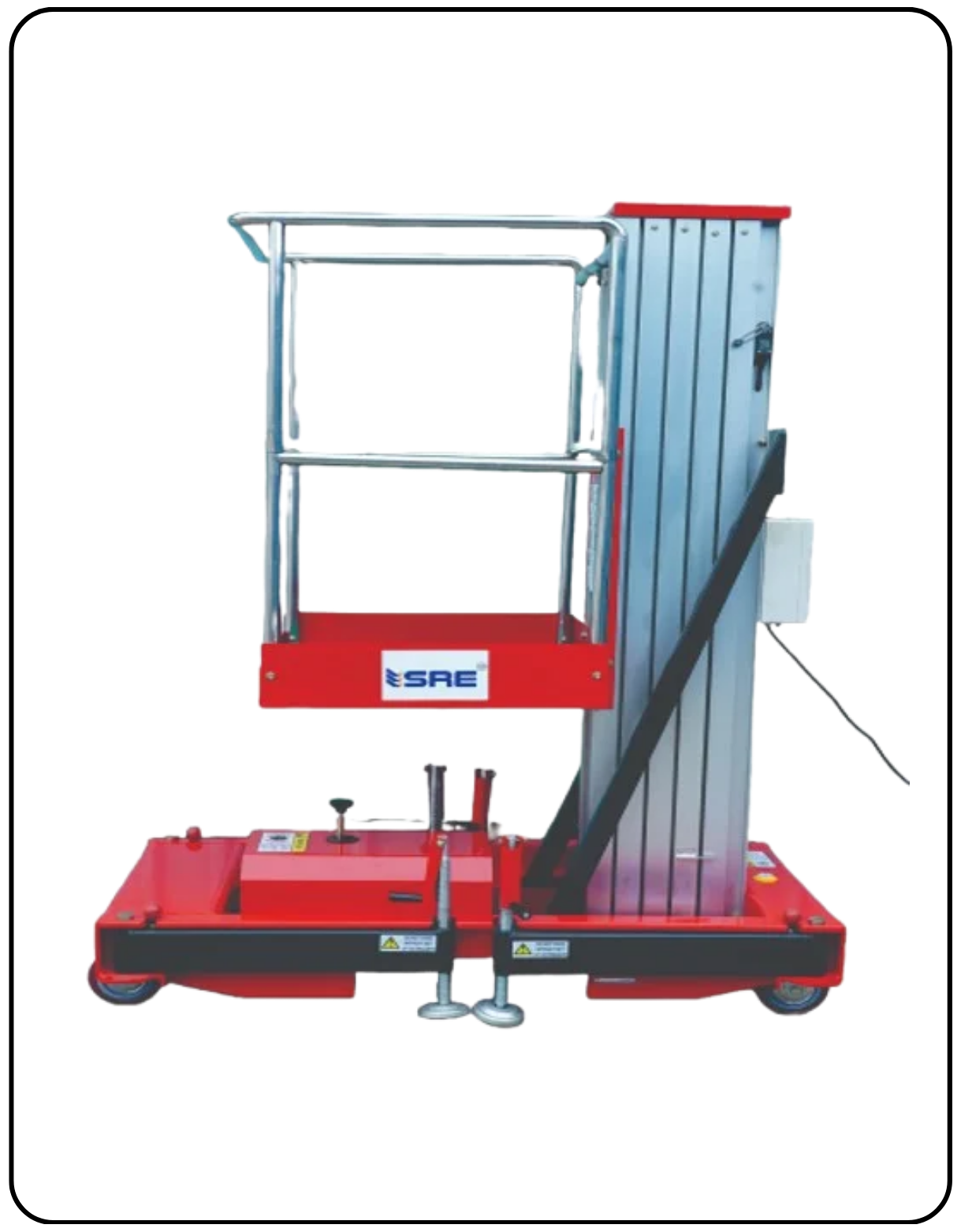
Facility managers, maintenance engineers, and EHS officers at manufacturing plants in Bhosri MIDC — the densely packed industrial zone on the northern edge of Pune hosting hundreds of engineering, automotive, and electronics manufacturers — frequently encounter the same height-access problem at their facilities: overhead MEP maintenance tasks (lighting, HVAC, fire suppression, cable trays) at 4–6 metre ceiling heights are being handled by workers climbing on improvised ladders or unstable makeshift scaffolding, creating a safety liability that violates Maharashtra Factories Act requirements and exposes plants to regulatory risk. The certified, compact solution that plant safety teams and procurement managers at Bhosri, Pune, and across Maharashtra now specify for this exact height range is the Aerial Lift in Bhosri — the SRE 151, a compact mast-type battery-powered elevated work platform rated at 130 kg single-person capacity and a maximum working height of 6 metres. Available from SRE Material Handling Equipment Pvt. Ltd. at Rs. 1,75,000 (taxes extra), manufactured under ISO 9001:2015 quality management in Ahmedabad, and supplied PAN India.
Key Features Of Aerial Lift SRE 151 That Match The Specific Height-Access Needs Of Bhosri And Pune Manufacturing Plants
6-Metre Working Height in a Compact Footprint — Built for Bhosri MIDC Factory Floor Constraints
Maintenance managers at manufacturing plants in Bhosri MIDC and Chakan know a practical floor-level reality: the available aisle width between production lines, machine rows, and storage racks in a typical Bhosri factory is rarely more than 1,500–2,000 mm. Larger self-propelled scissor lifts and boom lifts designed for open construction sites cannot access these tight factory aisles without disrupting production. The SRE 151 Aerial Lift is specifically designed for this constraint — it has a base dimension of approximately 900 × 650 mm in travel mode, allowing it to navigate through factory aisle widths of 1,000 mm+ before stabilising at the access point. At the work location, four outrigger legs deploy to a 1,800 × 1,800 mm stabilised footprint — providing a tip stability ratio of greater than 1.5:1 at full 6-metre working height per IS 3521 and FEM 1.001 standards. The mast sections are colour-coded and pin-locked, allowing a single technician to assemble the unit from transport mode to full working height within 20–30 minutes at any Bhosri or Pune factory location.
130 kg Single-Operator Platform — Correct Specification for Indoor MEP Maintenance at 6 Metres
EHS managers and plant safety officers at Bhosri automotive and electronics plants conducting risk assessments for overhead access work need to verify that a 130 kg platform rating is correct for their specific applications before purchase. The SRE 151 rated capacity of 130 kg covers a single operator with standard hand tools and a tool bag — the correct specification for the majority of indoor MEP maintenance tasks at 6-metre height, including: LED fixture replacement (typical lamp + fixture weight 3–8 kg), HVAC filter service, fire detector testing, cable tray cable pulling, and overhead pipe work. The platform dimensions are approximately 600 × 600 mm with a 1,100 mm guard rail on three sides and a manual entry gate on the fourth side. The battery-powered mast lift motor operates on a 24V / 55 Ah sealed lead-acid battery, providing approximately 25–35 full lift cycles (ground to 6 metres and return) per charge — sufficient for a half-day maintenance session before the unit requires overnight recharging from a standard 230V / 15A socket. A spring-loaded mechanical brake on the mast drive prevents uncontrolled descent in the event of any system fault — per IS 3521 safety requirements.
Applications Of Aerial Lift SRE 151 Across Industries In Bhosri, Pune, Maharashtra, And PAN India
Facility heads, maintenance team leaders, and procurement managers in Bhosri, Pune, Ahmedabad, and Bangalore specify the SRE 151 Aerial Lift (130 kg / 6 metre) for any single-operator height access task at 4–6 metre ceiling or structure height in an indoor factory, warehouse, or institutional building. Proven applications include:
- LED lighting replacement and maintenance at Bhosri MIDC factories: High-bay LED fixture replacement at 4–6 metre mounting heights — single operator completes jobs that previously required 3-worker scaffolding setups
- HVAC ductwork and AHU maintenance at Bhosri and Chakan plants: Filter replacement, duct inspection, and damper adjustment at suspended HVAC equipment in automotive paint shops and clean rooms
- Fire suppression system testing and maintenance at Pune industrial facilities: Sprinkler head inspection, heat detector testing, and suppression pipe joint checks at 4–6 metre ceiling heights
- Cable tray installation and cable pulling in Bhosri MIDC electronics plants: Overhead cable management during plant fit-out, expansion, and modification — battery operation eliminates extension cord hazard on crowded factory floors
- False ceiling and interior fit-out in commercial buildings in Pune and Noida: Grid ceiling installation, light fitting placement, and partition header fixing across large commercial floor plates at up to 6 metres
- Institutional building maintenance in Nashik, Aurangabad, and Jaipur: Hospital corridor and ward ceiling maintenance, school and college building MEP service, and government facility lighting maintenance
- Small equipment rental fleet deployment for Bhosri and Pune contractors: Rental companies purchasing the SRE 151 as a compact fleet asset for short-term hire to factory maintenance contractors — daily hire rate typically Rs. 1,500–3,000
- Retail and commercial fit-out in Gurugram, Faridabad, and Ambala: Shopping mall ceiling, signage installation, and showroom lighting design work at up to 6 metres
- Hotel and hospitality property maintenance in Pune, Jaipur, and Udaipur: Lobby chandelier maintenance, corridor ceiling MEP servicing, and restaurant overhead décor installation
- Clean room and pharmaceutical facility maintenance in Bhosri and Hyderabad: Overhead piping, HVAC, and lighting servicing in controlled environments — anti-static platform option available for ESD-sensitive areas
How SRE 151 Aerial Lift (6 Metre) Compares To SRE 152 (10 Metre) And Scaffold Tower For Bhosri And Gujarat Buyers
Procurement managers in Bhosri and Gujarat comparing aerial lift models and alternative access methods need to understand where the SRE 151 (6 metre, 130 kg) is the correct specification versus the larger SRE 152 (10 metre, 220 kg) or a conventional scaffold tower.
| Feature | Scaffold Tower (Aluminium) | SRE 151 Aerial Lift (6 m, 130 kg) | SRE 152 Aerial Lift (10 m, 220 kg) |
|---|---|---|---|
| Max Working Height | Up to 8 m (typical) | 6 metres | 10 metres |
| Platform Capacity | Multiple workers (200+ kg) | 130 kg single operator | 220 kg (2 persons) |
| Setup Time | 30–60 min erect + dismantle | 20–30 min single person | 30–45 min 2 persons |
| Base Footprint (travel) | 800 x 800 mm+ (per section) | 900 × 650 mm — narrow aisle capable | 1,200 × 700 mm |
| Battery Operation | N/A — manual | 24V / 55 Ah — 25–35 cycles/charge | 24V / 100 Ah — 30–40 cycles/charge |
| IS Safety Compliance | Manual — no electrical | IS 3521 + FEM 1.001 — mast brake + outrigger | IS 3521 + FEM 1.001 |
| Purchase Price (INR) | Rs. 25,000–80,000 | Rs. 1,75,000 (SRE 151) | Rs. 3,10,000 (SRE 152) |
The SRE 151 Aerial Lift at Rs. 1,75,000 is the correct specification for Bhosri and Pune factory facilities where the maintenance access height requirement is 4–6 metres and the primary user is a single maintenance technician. For facilities requiring 10-metre access or two-person platforms, the SRE 152 is recommended. SRE Material Handling Equipment Pvt. Ltd. can specify the correct model based on facility ceiling height and maintenance task list — contact SRE Material Handling Equipment Pvt. Ltd. for a free site-specific recommendation.
Technical Specifications And How To Order SRE 151 Aerial Lift For Bhosri, Gujarat, And PAN India
Plant managers and procurement officers in Bhosri, Pune, Ahmedabad, and Bangalore placing capital equipment orders need complete verified specifications. The SRE 151 Aerial Lift is supplied with: rated capacity 130 kg (single person + tools), maximum working height 6,000 mm, platform dimensions approximately 600 × 600 mm, guard rail height 1,100 mm with manual entry gate, base travel footprint 900 × 650 mm, outrigger stabilised footprint 1,800 × 1,800 mm, stability standard IS 3521 + FEM 1.001, mast drive 24V DC electric rack-and-pinion, battery 24V / 55 Ah sealed lead-acid, charger 24V smart — 230V / 15A single-phase, lift cycles per charge approximately 25–35 (ground to 6 m and return), mast brake spring-loaded mechanical — auto-engage on power loss, load test at 125% rated capacity. Standard delivery to Bhosri and Pune: 15–25 working days; bulk orders (3+ units): 25–35 working days. For related height-access solutions, explore the Aerial Work Platform range, the Mobile Scissor Lift for self-propelled access, and the Good Lift for goods elevation. Related blog reading: Self Propelled Scissor Lift Table Pune and Pit Mounted Scissor Lift Table in Mumbai. Submit an inquiry online for pricing and delivery confirmation.
Replace unsafe ladders with certified 6-metre aerial access — SRE 151 Aerial Lift at Rs. 1,75,000.
📞 Get Quote Now — Call +91 9316 208879 or +91 97247 22404IS 3521 + FEM 1.001 compliant · 125% load tested · Compact 900 x 650 mm base · ISO 9001:2015 certified
For authoritative international quality management certification applicable to aerial lift and mast platform manufacturers, see ISO 9001:2015 Quality Management System standard. For IS standards governing aerial work platforms and mast climbing units in India, visit Bureau of Indian Standards (BIS) — IS 3521. For internationally recognised aerial lift and elevated work platform safety guidelines applicable to Bhosri and Maharashtra facilities, refer to OSHA Aerial Lifts safety standard.
Frequently Asked Questions — Aerial Lift SRE 151 For Bhosri And Pune Industrial Buyers
Q1. What is the rated capacity, working height, and base footprint of the SRE 151 Aerial Lift for indoor factory use in Bhosri MIDC?
The SRE 151 Aerial Lift is rated at 130 kg (single operator + tools) with a maximum working height of 6,000 mm (6 metres). The travel base footprint is 900 × 650 mm — narrow enough to navigate factory aisles of 1,000 mm+ in Bhosri MIDC plants. Outrigger stabilised footprint is 1,800 × 1,800 mm. SRE Material Handling Equipment Pvt. Ltd., an ISO 9001:2015 certified manufacturer, supplies the SRE 151 at Rs. 1,75,000 with a 125% load test certificate, compliant with IS 3521 and FEM 1.001.
Q2. What is the difference between the SRE 151 Aerial Lift (6 metre) and the SRE 152 (10 metre) — which is right for Bhosri and Pune factories?
The SRE 151 (130 kg / 6 m / Rs. 1,75,000) is designed for single-operator indoor maintenance tasks at 4–6 metre ceiling heights — the most common ceiling height in Bhosri MIDC and Pune manufacturing facilities. It has a narrower base (900 × 650 mm travel) for tight indoor aisles. The SRE 152 (220 kg / 10 m / Rs. 3,10,000) is designed for higher ceilings, two-person platforms, and outdoor or construction applications. Choose the SRE 151 when your ceiling height is 6 metres or below and your primary user is a single maintenance technician.
Q3. How many lift cycles does the SRE 151 Aerial Lift battery provide per charge, and what power socket is needed for charging at Bhosri factories?
The SRE 151 Aerial Lift’s 24V / 55 Ah sealed battery provides approximately 25–35 full lift cycles per charge — ground level to 6 metres and return — supporting a typical half-day maintenance session before requiring overnight recharge. The 24V smart charger plugs into any standard 230V / 15A single-phase wall socket — the standard socket available throughout Bhosri MIDC factory buildings. Full charge time is approximately 6–8 hours, meaning overnight charging in the maintenance workshop prepares the unit for next-morning deployment anywhere in the facility.
Q4. What safety certifications and mechanical safety devices does the SRE 151 Aerial Lift carry for compliance with Bhosri MIDC factory safety audits?
The SRE 151 Aerial Lift is manufactured to IS 3521 and FEM 1.001 standards with a factory 125% load test certificate — meeting Maharashtra Factories Act documentation requirements for elevated work platforms. Mechanical safety devices include: spring-loaded mast brake (auto-engages on power loss, prevents controlled descent failure), outrigger interlock (mast cannot elevate unless all four outriggers are deployed), guard rail on three sides with manual gate, and an emergency lowering valve for manual descent on battery failure. SRE Material Handling Equipment Pvt. Ltd. provides factory test report with every unit.
Q5. Bhosri ya Pune ke manufacturing plant ke liye Aerial Lift SRE 151 ki delivery aur assembly mein kitna time lagta hai?
Bhosri aur Pune ke liye SRE 151 Aerial Lift ki standard delivery 15 se 25 working days mein hoti hai. On-site assembly ek single technician kar sakta hai 20–30 minutes mein — color-coded pin-lock mast sections se. Battery charge full karein (6–8 hours, 230V socket) aur unit ready hai. SRE Material Handling Equipment Pvt. Ltd. ke Ahmedabad plant se Maharashtra ke sabhi industrial zones tak delivery available hai. Load test certificate aur operator manual Hindi + English mein included hai.
Q6. Pune ya Gujarat ke industrial plant ke liye 6-metre Aerial Lift SRE 151 aur scaffold tower mein se kaunsa better invest hai?
Pune aur Gujarat ke industrial plants ke liye comparison: scaffold tower (Rs. 25,000–80,000) setup/dismantle mein 30–60 minutes lagta hai har location change par. SRE 151 Aerial Lift (Rs. 1,75,000) ek single technician 20–30 minutes mein setup karta hai aur battery se operate hota hai. Agar plant mein maintenance team 5+ location changes per week karta hai at 4–6 metre heights, toh SRE 151 6–12 months mein scaffold rental cost recover kar leta hai aur safety compliance bhi better hoti hai.
Q7. Kya SRE 151 Aerial Lift ki spare parts aur AMC service Noida, Faridabad, ya Hyderabad mein available hai?
Haan. SRE Material Handling Equipment Pvt. Ltd. ke Ahmedabad manufacturing facility se spare parts — 24V battery packs, mast rack-and-pinion drive assemblies, outrigger legs, guard rail sections, aur charger units — Noida, Faridabad, Hyderabad, aur PAN India ke liye 2–5 working days mein courier dispatch hote hain. AMC (Annual Maintenance Contract) available hai jisme annual inspection, battery capacity test, mast brake function check, aur outrigger joint inspection covered hai.