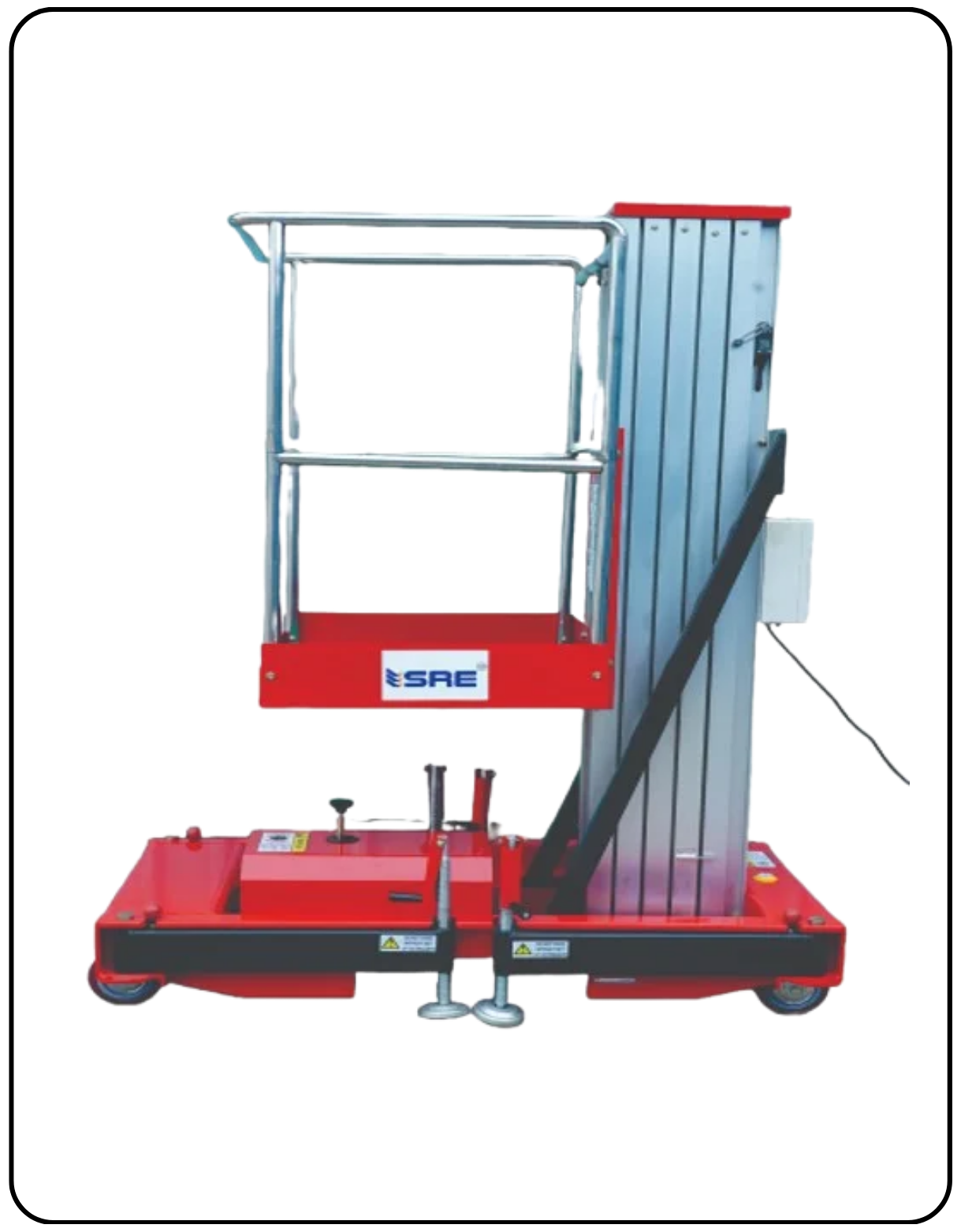
130 Kg–6 Meter (All Size Available)
Rs. 175000
(Taxes to be paid extra)
Brand: SRE
SKU: SRE 151
Min Order Qty: 1
Applications Of Aerial Lift And Key Features Of Aerial Lift in Nashik
Maintenance managers and facility engineers in Nashik, Pune, and Aurangabad who need to access heights between 3 and 6 metres in narrow warehouse aisles, production facility corridors, or between racking systems face a specific working-at-height problem that a full-size scissor lift cannot solve: the scissor lift’s wide base footprint — typically 800–1200 mm wide — cannot enter aisle widths under 1,200 mm, and its platform area far exceeds what a single-operator overhead maintenance task actually needs. This makes the scissor lift expensive, slow to position, and operationally over-specified for single-person, narrow-aisle overhead access. The Aerial Lift in Nashik from SRE Material Handling Equipment Pvt. Ltd. is the purpose-built solution — the SRE Single Mast Aerial Work Platform (SKU: SRE 151) reaches 6-metre working height with a 130 kg platform capacity, priced at Rs. 1,75,000, on a base footprint narrow enough to operate in rack aisles as tight as 800 mm wide across Nashik, Aurangabad, and all Maharashtra industrial facilities.
How Aerial Lifts Are Used in Narrow-Aisle and High-Bay Industrial Facilities Across Nashik, Pune, and Gujarat
A single mast aerial work platform — also called a single mast aerial lift, mast climber, or personnel lift — uses a single vertical mast column to carry a small operator platform to working height. The mast is driven by a DC electric motor and rack-and-pinion or chain-drive mechanism, raising the operator at a controlled speed of approximately 0.1–0.15 m/s. The entire unit — mast, base, and platform — fits within a base footprint of approximately 800 mm × 1200 mm, making it the only working-at-height solution that physically enters standard warehouse rack aisles of 900–1,100 mm clear width. In Nashik’s high-bay warehouses and manufacturing facilities, this narrow-aisle capability reduces the setup time for overhead maintenance tasks from 30–60 minutes (scaffolding) to under 5 minutes — the aerial lift drives in, rises to working height, and the operator begins work immediately.
Key Applications of Aerial Lift Across Nashik’s Industrial Sectors
- Warehouse Rack Aisle Maintenance: Overhead light replacement, sprinkler head inspection, and rack beam repair in high-bay warehouses in Nashik, Bhiwandi, and Noida with rack aisle widths of 900–1,100 mm.
- Automotive Plant Narrow-Corridor Access: Overhead conveyor maintenance, cable tray installation, and sensor replacement in narrow production corridors in Nashik automotive plants and Pune Tier-1 suppliers.
- Pharmaceutical GMP Facility Maintenance: Single-person overhead access for HVAC duct, cleanroom lighting, and process pipe maintenance in GMP pharma plants in Nashik, Aurangabad, and Ahmedabad — battery-electric, zero fume.
- Cold Storage & Refrigeration Plant Maintenance: Overhead evaporator unit service and condenser pipe maintenance in cold storage facilities in Gujarat and Maharashtra — lithium-ion battery variant maintains full performance at -5°C.
- Data Centre & IT Facility Access: Cable management, server rack-top access, and cooling system maintenance in data centres in Pune, Bangalore, and Hyderabad — zero-emission electric operation required.
- Commercial Building Interior Maintenance: Ceiling, lighting, and MEP maintenance in commercial buildings, hotels, and hospitals in Nashik, Pune, and Mumbai where aisle widths restrict larger platforms.
- Printing & Packaging Plants: Machine-top access, dust collection duct maintenance, and overhead conveyor service in printing facilities in Nashik, Indore, and Bhopal.
- Steel Fabrication & Engineering Shops: Overhead crane beam inspection, cable tray installation, and roof truss maintenance in engineering workshops in Nashik, Vatva, and Bhavnagar.
SRE Material Handling Equipment Pvt. Ltd., an ISO 9001:2015 certified, MSME-registered, Make in India manufacturer in Ahmedabad, supplies aerial lifts in working heights from 4 metres to 10 metres and platform capacities from 130 kg to 250 kg. Standard dispatch to Nashik, Pune, and across Gujarat, Maharashtra, and Rajasthan within 10–21 working days, with battery, charger, guardrail set, and load test certificate included.
Key Technical Features of SRE Aerial Lift (SKU: SRE 151) That Purchase Managers in Nashik, Aurangabad, and Rajasthan Must Verify
The SRE Single Mast Aerial Lift (SRE 151) carries 130 kg — one operator plus approximately 30–50 kg of tools — to a working height of 6 metres on a mast fabricated from IS 2062 Grade A MS steel with precision-machined rack-and-pinion drive tracks. The platform dimensions are typically 600 mm × 800 mm — sufficient for one operator plus a tool bag, drill, and light fitting kit. The base footprint of the standard unit is approximately 800 mm × 1200 mm, enabling deployment in rack aisles of 900 mm and above. The 24V or 70Ah lithium-ion battery provides a rated operating time of 8 hours per charge cycle, suitable for a full single-shift maintenance program in a Nashik or Aurangabad facility.
Safety Interlocks, Drive System, and Certification Requirements for Nashik Industrial Deployment
The SRE SRE 151 aerial lift includes the following safety systems: full-perimeter guardrails at 1100 mm height with mid-rail and integral toeboard; a drive interlock that prevents drive travel when the mast platform is elevated above 1.8 metres, eliminating tip-over risk during transit; an emergency descent system that allows controlled platform lowering at a maximum rate of 0.15 m/s in the event of battery or motor failure; and an overload sensor that prevents the platform from rising if total load exceeds 130 kg rated capacity. Every unit undergoes a factory load test at 125% rated capacity (163 kg) before dispatch, with a signed test certificate issued — satisfying EHS compliance documentation requirements for Nashik MNC automotive and pharma facilities. Per ISO 9001 quality management standards. Compare with the Aerial Lift in Mumbai for fleet planning across Maharashtra.
Single Mast Aerial Lift vs. Double Mast AWP vs. Self Propelled Scissor Lift — Which Is Right for Factory Owners in Nashik, Bangalore, and Noida?
The specification decision between a single mast aerial lift, a double mast aerial work platform, and a self propelled scissor lift depends on three variables: aisle width, working height, and number of operators. A single mast aerial lift at Rs. 1,75,000 — like the SRE SRE 151 — is correct for one operator, narrow-aisle access up to 6 metres. A double mast AWP suits two-person tasks at 8–10 metre heights where higher stability is needed. A self propelled scissor lift — at Rs. 6,90,000 — is specified when the working area exceeds 2,000 sq ft, the platform must carry two operators plus heavy tools, and frequent repositioning across large floor areas is required. For Nashik facilities with narrow aisle maintenance programs — particularly in high-bay FMCG warehouses, automotive parts stores, and pharma cleanrooms — the single mast aerial lift is the most practical and cost-effective specification.
For maintenance fleet procurement by facility management companies and contract maintenance operators in Gurugram, Faridabad, Ambala, and Rohtak servicing multiple Nashik and Maharashtra industrial sites, SRE Material Handling Equipment Pvt. Ltd. offers fleet pricing on 3+ unit orders with uniform documentation, phased delivery, and AMC options. Explore the full Aerial Work Platform range from SRE and Mobile Scissor Lift solutions for comprehensive height-access fleet planning. Also view Self Propelled Scissor Lift Table Pune for comparison context. 📞 Call Now: +91 9316 208879 — Get Free Aerial Lift Quote for Nashik. Per Make in India standards, all SRE units are manufactured in Ahmedabad with local spare parts availability. Send Bulk Aerial Lift Fleet Inquiry to SRE Material Handling Equipment Pvt. Ltd.
Why Logistics Heads and EHS Managers in Nashik, Bhavnagar, Kutch, and Ghandhidham Prefer SRE Aerial Lifts Over Scaffolding and Ladders
In Nashik’s industrial zones — from the MIDC Satpur and Ambad engineering clusters to the food processing parks on the Mumbai-Agra highway — EHS managers are under increasing regulatory pressure to eliminate ladder and makeshift scaffolding use for routine overhead maintenance. Every ladder-based maintenance incident — a slip, a dropped tool, a destabilisation event — triggers an internal incident report, potential regulatory inspection, and production stoppage. A SRE aerial lift with 1100 mm guardrails, drive interlock above 1.8 metres, and a factory-issued load test certificate provides the documented, certified working-at-height solution that EHS compliance teams in Nashik, Ghandhidham, and Kutch need to replace ladder use permanently. The battery-electric drive means zero fume, zero noise — deployable in food processing, pharma, and cleanroom environments without any special ventilation requirements. For BIS-compliant working-at-height safety, the SRE aerial lift is the correct specification.
Frequently Asked Questions — Aerial Lift in Nashik
What is the platform capacity and working height of an Aerial Lift for narrow-aisle maintenance in Nashik?
The SRE Aerial Lift (SKU: SRE 151) carries 130 kg — one operator plus tools — to a working height of 6 metres on a base footprint of approximately 800 mm × 1200 mm, enabling deployment in rack aisles as narrow as 900 mm. Custom working heights from 4 metres to 10 metres and platform capacities up to 250 kg are available for Nashik facilities with specific height requirements. Factory load-tested at 125% rated capacity (163 kg) with certificate.
What is the price of an Aerial Lift in Nashik and what safety certifications and equipment are included?
The Aerial Lift price in Nashik is Rs. 1,75,000 per unit (taxes extra) for the standard 130 kg, 6-metre model (SRE 151). SRE Material Handling Equipment Pvt. Ltd., an ISO 9001:2015 certified Make in India manufacturer, includes battery (24V 70Ah lithium-ion), charger, full 1100 mm guardrail set, drive interlock, overload sensor, emergency descent system, and factory load test certificate at 125% capacity. Dispatch to Nashik within 10–21 working days.
How does a Single Mast Aerial Lift compare to scaffolding for routine overhead maintenance in Nashik’s industrial facilities?
Scaffolding erection for a single overhead maintenance point in a Nashik industrial facility takes 30–60 minutes and requires 2–3 workers to set up, creating Rs. 3,000–8,000 of labour cost per setup. An SRE aerial lift deploys in under 5 minutes by one operator, with 8-hour battery runtime and repositioning in seconds — recovering its Rs. 1,75,000 purchase price within 20–40 scaffolding setups. For facilities in Nashik with regular monthly overhead maintenance programs, the payback is typically within 3–6 months.
What safety features does the SRE Aerial Lift include for EHS compliance in Nashik’s pharma and automotive facilities?
The SRE Aerial Lift (SRE 151) includes: 1100 mm full-perimeter guardrails with mid-rail and toeboard; drive interlock above 1.8 metres preventing travel at elevated height; overload sensor preventing lift above 130 kg; and emergency descent at maximum 0.15 m/s. Battery-electric drive generates zero fumes — fully approved for GMP pharma and food processing environments in Nashik. All units ship with a factory load test certificate at 125% capacity for EHS compliance documentation.
Nashik ya Pune ke narrow-aisle warehouse ke liye Aerial Lift ki delivery time aur minimum order kya hai?
Nashik aur Pune ke liye SRE Material Handling Equipment Pvt. Ltd. standard models 10 se 21 working days mein deliver karta hai. Minimum order 1 unit. Rs. 1,75,000 mein 24V 70Ah lithium-ion battery, charger, 1100 mm guardrails, drive interlock, emergency descent system, aur factory load test certificate included hain. ISO 9001:2015 certified — har unit ke saath EHS compliance documentation milta hai. 3+ units fleet orders pe volume pricing available hai.
Nashik ke pharma ya food processing plant mein Aerial Lift ka kaun sa model suitable hoga aur minimum aisle width kya chahiye?
Nashik ke pharma GMP facilities aur food processing plants ke liye SRE 151 (6-metre working height, 130 kg platform) standard specification hai. Minimum clear aisle width 900 mm required hai. Battery-electric operation — zero fumes, zero emissions — GMP compliance requirements satisfy karta hai. SS 304 platform surface food-grade facilities ke liye available option hai. Overhead HVAC, duct, aur lighting maintenance ke liye ideal unit hai. SRE Material Handling Equipment Pvt. Ltd. free technical consultation provide karta hai.
Kya Aerial Lift ki battery service aur spare parts Nashik, Aurangabad ya Jalgaon mein available hain?
Haan — SRE Material Handling Equipment Pvt. Ltd. ka service network Nashik, Aurangabad, Jalgaon, aur Maharashtra ke sabhi major industrial cities mein available hai. 24V 70Ah lithium-ion battery packs, charger units, drive controller boards, aur guardrail components 48–72 ghante mein available hain. Annual maintenance: battery capacity check har 6 mahine, mast drive chain lubrication, overload sensor calibration — total annual service cost under Rs. 3,000–5,000.