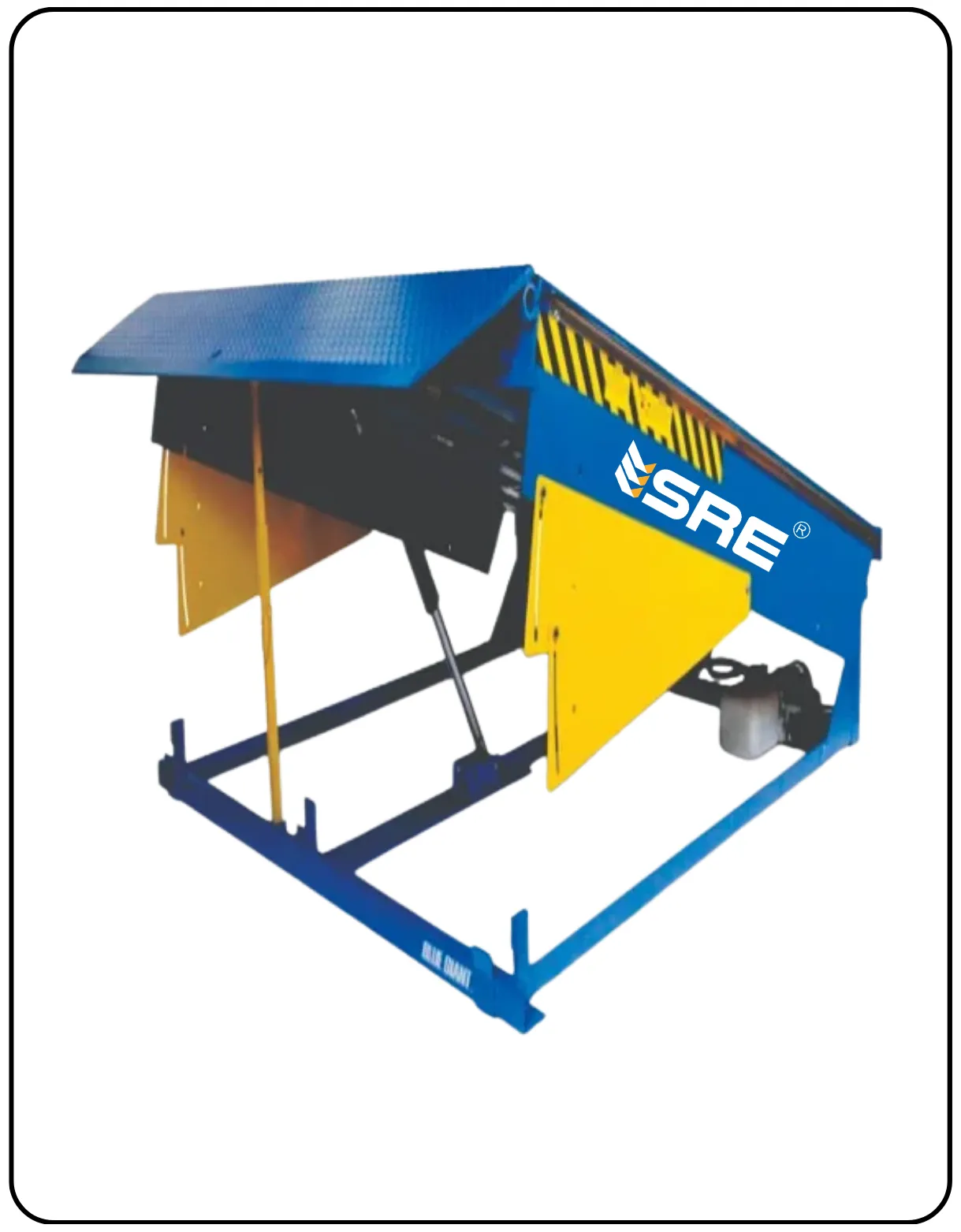
10 Ton x 1.6 Meter (All Size Available)
Rs. 230000
(Taxes to be paid extra)
Brand: SRE
SKU: SRE 163
Min Order Qty: 1
Uneven truck bed heights create a daily problem in warehouses, factories, and dispatch hubs where loading and unloading must move fast without damaging goods or slowing labor. A reliable Dock Leveler in Rajkot solves this issue by creating a stable bridge between the loading bay and the vehicle bed. The result is safer movement of pallets, trolleys, and forklifts, better load handling, and higher productivity for industrial buyers and warehouse managers.
Many facilities in Rajkot still depend on improvised ramps or manual adjustments when trucks arrive at different heights. That creates risk during every shift because operators face unstable transfer points, goods move unevenly, and vehicles spend more time at the dock. A dock leveler addresses this problem with controlled height compensation and a strong loading platform. The result is smoother loading cycles, lower handling damage, and faster turnaround for warehouses in Rajkot, Ahmedabad, Pune, Vadodara, Chennai, Hyderabad, Bangalore, Jaipur, and Noida.
Procurement teams usually need loading bay equipment that is durable, safe, and easy to justify as a long-term investment. SRE Material Handling Equipment Pvt. Ltd. offers a dock leveler built for demanding industrial movement where capacities, dimensions, safety, and operating reliability matter. The result is a practical industrial dock leveler choice for facilities that want to improve dispatch speed, reduce operator risk, and strengthen warehouse efficiency.
Why Industries Need a Dock Leveler in Rajkot
Warehouses often face a common problem when truck floor heights do not match dock height and every loading cycle requires extra effort to compensate for that gap. A dock leveler solves this issue by forming a stable and adjustable bridge between the dock and the vehicle. The result is smoother forklift movement, better transfer consistency, and less delay in dispatch operations.
Many industrial units also struggle with product damage during loading because uneven access forces pallets and wheeled equipment to cross unstable surfaces. A dock leveler reduces this risk with a flat and secure transition path that supports controlled movement. The result is lower material loss, better safety, and improved confidence for warehouse supervisors.
Plant managers and factory owners need every loading bay to support throughput instead of creating a bottleneck. A dock leveler improves the dock interface and allows teams to work with more speed and control, even during repeated truck handling cycles. The result is higher productivity, better labor use, and more reliable loading schedules.
Procurement heads also face pressure to invest in equipment that reduces hidden losses rather than adding operational complexity. A dock leveler provides a dedicated loading solution that supports heavy-duty movement without the limitations of temporary ramps or manual methods. The result is a stronger case for a commercial warehouse equipment purchase that delivers long-term value.
Applications of Dock Leveler in Rajkot
Loading areas become inefficient when the dock-to-truck gap changes from one vehicle to another and each transfer needs manual adjustment. A dock leveler solves this by adapting the loading point to support faster and safer movement across the bay. The result is smoother logistics flow across multiple industrial applications.
1. Warehouses and Distribution Centers
Distribution centers often deal with high truck movement and fast turnaround expectations, but uneven loading points slow the process and increase handling risk. A dock leveler creates a stable platform for forklifts, pallet trucks, and manual trolleys. The result is faster loading, reduced waiting time, and improved dock efficiency.
2. Manufacturing Plants
Manufacturing units need uninterrupted dispatch of raw materials, semi-finished goods, and finished products, but poor dock access creates delays between production and shipment. A dock leveler connects the production outflow to the transport vehicle more smoothly. The result is better workflow continuity and lower dispatch disruption.
3. FMCG and Packaging Units
Fast-moving goods operations lose time when loading teams cannot move packed goods quickly and safely into incoming or outgoing vehicles. A dock leveler supports repeated pallet movement with better alignment and stable access. The result is improved shift output and lower damage risk during dispatch.
4. Cold Storage and Food Processing Facilities
Cold storage and food units often need quick vehicle loading to protect product condition, but manual loading support causes delay and exposure. A dock leveler helps create an efficient transfer point that shortens loading time. The result is better handling speed and stronger process control in temperature-sensitive operations.
5. Engineering and Heavy Industry
Engineering units handle dense loads and palletized goods that require steady vehicle access, but uneven dock entry increases the chance of equipment strain and material movement problems. A dock leveler improves the bridge between the warehouse floor and truck bed. The result is safer heavy-duty transfer and more dependable dock performance.
6. E-commerce and Retail Fulfillment Hubs
Fulfillment operations depend on fast inbound and outbound handling, but dock delays create ripple effects across sorting, staging, and dispatch. A dock leveler helps maintain loading speed through a more predictable and stable docking point. The result is better shipment flow and improved daily operational planning.
- Central warehouses
- Industrial dispatch bays
- Manufacturing loading docks
- Packaging and FMCG units
- Cold storage logistics points
- E-commerce fulfillment centers
- Heavy engineering plants
- Third-party logistics hubs
Businesses reviewing complete loading bay systems can also explore
dock leveler manufacturer and supplier solutions and
industrial dock leveler product details. The result is better planning for facilities that need a full dock handling setup rather than a partial fix.
Key Features of SRE Dock Leveler
Many product pages list specifications without explaining how those features solve real loading bay problems. Industrial buyers need clarity on how each feature supports daily warehouse movement. The result is easier product evaluation and more confident procurement decisions.
- 10 Ton capacity for heavy-duty warehouse and industrial loading
- 1.6 Meter operating dimension for practical dock bridging requirements
- Heavy-duty fabricated structure for continuous industrial use
- Stable platform for forklifts, pallet trucks, and trolley movement
- Designed for safer dock-to-truck transfer
- Suitable for high-frequency loading bay operations
- Available in all sizes based on application need
- Built for improved loading speed and lower manual handling risk
One major problem at the loading dock is equipment mismatch between load demand and platform strength. A 10 ton dock leveler helps solve this by supporting heavier industrial transfer needs with a stronger platform capacity. The result is better handling confidence for facilities moving palletized stock, machinery parts, or bulk warehouse loads.
Another issue is dock movement instability when forklifts cross from the bay to the truck bed under load. A well-built dock leveler provides a more secure transition point and reduces the chance of uneven movement. The result is stronger safety, reduced operator hesitation, and better flow at the loading dock.
Many warehouses also need equipment that fits their actual dock layout instead of forcing costly structural changes. SRE offers all size availability to support application-specific requirements more effectively. The result is easier site matching and better use of existing warehouse infrastructure.
Facilities comparing related regional options may also review
dock leveler applications in Ahmedabad and
dock leveler use cases in Mumbai. The result is broader understanding for buyers who manage multi-location warehousing or dispatch networks.
Technical Specifications of Dock Leveler in Rajkot
Approval delays often happen when engineering and procurement teams do not get clear commercial and technical details in one place. A specification table solves that issue by organizing the product information for easy review. The result is faster evaluation and smoother internal discussion.
| Parameter | Specification |
|---|---|
| Product Name | Dock Leveler |
| Location Focus | Rajkot |
| Capacity | 10 Ton |
| Operating Dimension | 1.6 Meter |
| Availability | All Size Available |
| Price | Rs. 230000 |
| Taxes | Extra as applicable |
| Brand | SRE |
| SKU | SRE 163 |
| Minimum Order Quantity | 1 Unit |
Buyers often struggle when loading equipment listings mention only price without enough operational data. Clear details such as 10 Ton capacity, 1.6 Meter size, and SKU information help teams match the equipment to actual dock traffic and handling needs. The result is faster technical approval and more accurate buying decisions.
Benefits of Installing a Dock Leveler
Many facilities continue to rely on temporary dock adjustments or unsafe loading methods because they appear manageable in the short term. That approach creates repeated losses through delay, strain, product damage, and poor dock productivity. A dock leveler provides a dedicated solution built for structured loading operations. The result is better warehouse performance and stronger operational control.
1. Better Load Handling
Unstable loading surfaces make it hard to move goods consistently between dock and vehicle, especially when heavy pallets or wheeled equipment are involved. A dock leveler creates a stable bridge that supports smooth transfer. The result is improved load handling and lower risk of goods shifting during movement.
2. Improved Safety at the Loading Bay
Dock gaps and uneven access points create avoidable hazards for forklift operators, warehouse staff, and supervisors. A dock leveler reduces those hazards by making the transition between the dock and truck more secure. The result is better safety and lower risk of injury, slip, or load drop incidents.
3. Higher Productivity
Loading delays reduce the total number of vehicles a warehouse can handle in a shift and create pressure across dispatch planning. A dock leveler helps speed up transfer by reducing manual adjustment and movement interruptions. The result is higher productivity, faster truck turnaround, and better use of labor and equipment.
4. Reduced Product Damage
Goods often get damaged when pallets hit uneven dock edges or when handling equipment loses stability during entry and exit. A dock leveler supports a smoother path and more controlled movement. The result is lower damage cost and better product condition during shipment.
5. Better Forklift Movement
Forklifts need a predictable surface when entering and leaving a truck under load, but dock height variation makes that difficult. A dock leveler improves alignment and movement support for forklift-based operations. The result is safer equipment use and better handling speed at the loading point.
6. More Professional Warehouse Infrastructure
Warehouses that use improvised loading support often face repeated inefficiency and poor process control. A dock leveler upgrades the dock area into a dedicated transfer station that matches modern logistics requirements. The result is a stronger operational image and better long-term infrastructure value.
Businesses planning regional warehouse upgrades can also review
dock leveler manufacturer options in Gujarat and
dock leveler supply across India. The result is easier comparison for companies managing multiple sites or future expansion plans.
Dock Leveler vs Conventional Loading Methods
Buyers often need to compare a dock leveler against ramps, manual bridging methods, or unstructured loading techniques before approving a purchase. The wrong approach may seem low-cost at first but creates higher losses over time. The result is weak throughput and poor dock reliability.
| Criteria | Dock Leveler | Temporary Ramp / Manual Method |
|---|---|---|
| Load Handling | Stable and controlled | Inconsistent and risky |
| Safety | Higher operator protection | Lower safety reliability |
| Productivity | Faster vehicle turnaround | Slower loading cycles |
| Forklift Compatibility | Better dock-to-truck movement | Limited and unstable |
| Damage Risk | Lower with smoother transfer | Higher due to uneven movement |
| Long-Term Value | Professional warehouse solution | Short-term workaround only |
The main problem with temporary loading methods is inconsistency because each truck height and each operator approach may differ. A dock leveler standardizes the transfer point and makes dock movement more predictable. The result is better dock discipline and stronger shift-level performance.
Manual bridging methods also increase the physical effort needed to maintain loading speed, especially during continuous operations. A dock leveler reduces that dependence on manual correction by providing a repeatable mechanical solution. The result is better warehouse control and a stronger basis for a serious industrial purchase.
Why Choose SRE Material Handling Equipment Pvt. Ltd.
Industrial buyers often face a market where many suppliers promote similar-looking loading equipment without clearly addressing practical warehouse needs. SRE Material Handling Equipment Pvt. Ltd. focuses on usable industrial solutions built for day-to-day material movement challenges. The result is better fitment, clearer buying confidence, and stronger long-term value.
- Industrial-focused loading bay solutions
- Clear commercial and technical product details
- Suitable for warehouses, factories, and distribution hubs
- All size availability based on site requirement
- Relevant for Indian operating conditions
- Practical support for buyer and warehouse teams
Warehouse managers need equipment that integrates into existing loading schedules without creating new service confusion or process instability. SRE dock levelers are positioned as practical equipment for facilities that need safer and faster truck access. The result is smoother loading operations and better operational control at the dock.
Procurement heads also need a supplier that understands application needs, not just price points. SRE supports industrial users across Rajkot, Ahmedabad, Pune, Vadodara, Chennai, Hyderabad, Bangalore, Jaipur, and Noida with material handling solutions relevant to real factory and warehouse conditions. The result is a stronger sourcing option for companies looking for a trusted dock leveler supplier.
Operational Relevance Across Major Indian Cities
Different industrial regions face different shipment volumes, but most share the same problem of uneven dock access and loading delays. A Dock Leveler in Rajkot is equally relevant to warehouse and factory operations in Ahmedabad, Pune, Vadodara, Chennai, Hyderabad, Bangalore, Jaipur, and Noida. The result is broader use value for companies that operate across multiple industrial markets.
In Ahmedabad and Vadodara, engineering and manufacturing units need steady dispatch support for palletized and industrial loads. In Pune and Chennai, automotive and production centers depend on predictable dock movement to protect loading schedules. The result is better logistics alignment in high-throughput industrial environments.
In Hyderabad, Bangalore, Jaipur, and Noida, growing warehouse and distribution networks need more structured loading infrastructure to support fast inbound and outbound handling. A dock leveler helps strengthen that infrastructure with safer and more efficient transfer support. The result is improved dock performance where shipment speed and loading discipline matter every day.
Quality and Safety References
Buyers often want more than a product description because loading bay equipment must align with broader quality and workplace safety expectations. Reviewing recognized standards and guidance helps teams evaluate dock systems more responsibly. The result is stronger due diligence before purchase.
- ISO standards reference for industrial quality systems
- OSHA workplace safety guidance
- MSME India resources for industrial businesses
Equipment buying becomes weaker when quality and safety context is ignored during evaluation. These authority resources help warehouse and plant teams review loading bay solutions with a wider operational perspective. The result is a more informed and credible procurement process.
Get Quote for Dock Leveler in Rajkot
Uneven truck access, slower loading cycles, and unsafe transfer points reduce efficiency across the warehouse and dispatch chain. A Dock Leveler in Rajkot from SRE gives your team a practical way to improve load handling, increase productivity, and strengthen safety at the loading bay. The result is a more dependable dock operation and better daily shipment performance.
If your facility is planning a new loading dock setup or replacing an inefficient manual system, this is the right time to review specifications and commercial details. SRE Material Handling Equipment Pvt. Ltd. can support your requirement with a suitable industrial dock leveler for warehouse or factory dispatch use. The result is faster decision-making and a stronger loading infrastructure for long-term use.
Talk to SRE about dock leveler requirements and
send your warehouse equipment inquiry.
Frequently Asked Questions
1. What is the capacity of the Dock Leveler in Rajkot?
Buyers often need a quick technical summary before comparing equipment options. This SRE dock leveler comes with a 10 Ton capacity. The result is easier evaluation for heavy-duty warehouse and industrial loading needs.
2. What is the size of this dock leveler?
Size mismatch can make loading bay equipment unsuitable for real site conditions. This model is listed as 10 Ton x 1.6 Meter. The result is clearer planning for dock layout and operating fit.
3. What is the listed price of the Dock Leveler in Rajkot?
Commercial clarity is important for procurement approval and budgeting. The listed price is Rs. 230000, with taxes extra as applicable. The result is better cost visibility during purchase planning.
4. Where is a dock leveler commonly used?
Some buyers assume dock levelers are only for large logistics hubs, which limits proper evaluation. They are commonly used in warehouses, factories, dispatch bays, distribution centers, and industrial loading docks. The result is broader application relevance for many industrial users.
5. Why is a dock leveler better than a temporary loading ramp?
Temporary ramps often create instability and slow movement during truck loading. A dock leveler offers a more stable and consistent dock-to-truck bridge for forklifts and pallet movement. The result is better safety, improved load handling, and stronger productivity.
6. Are custom sizes available for this dock leveler?
Standard equipment dimensions do not always fit every warehouse loading bay. SRE states that all sizes are available based on requirement. The result is better application matching and easier site-specific planning.
7. How can I request a quote from SRE?
Buyers often lose time when the contact path is unclear. You can request pricing, technical details, and application support directly through the SRE contact page. The result is faster communication and a smoother buying process.