
Mobile Aerial Work Platform in Rajkot — Applications, Key Features & Portability Guide
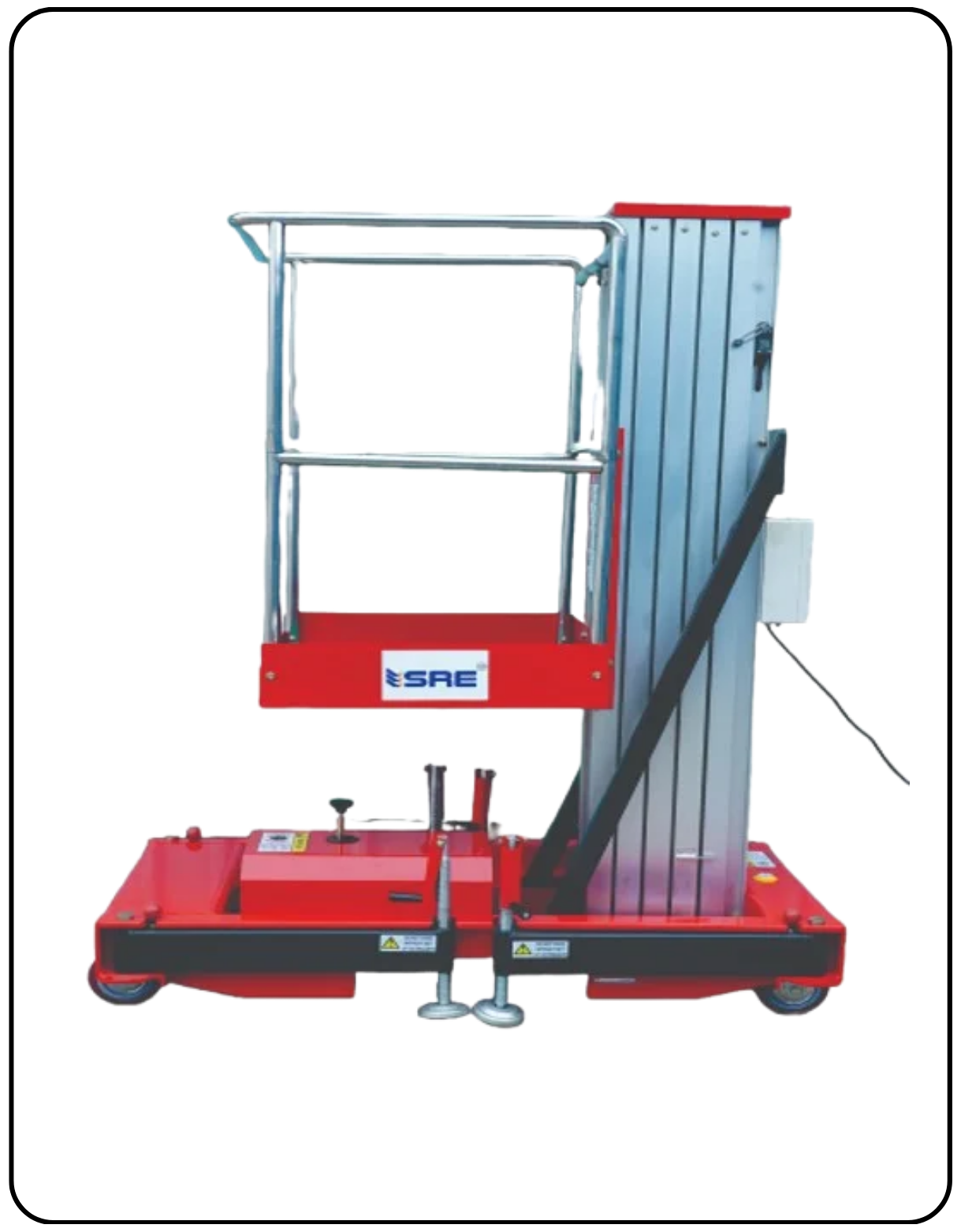
The specific limitation that separates a mobile aerial work platform from a fixed elevated access system is precisely what makes it most valuable in Rajkot’s diverse engineering and manufacturing environment: it moves. A fixed overhead crane or suspended platform serves one position. A mobile aerial work platform serves every elevated position throughout the facility — the same unit that services a lighting fixture this morning positions under a different beam for equipment maintenance this afternoon, and moves to a racking bay in the afternoon shift. The Mobile Aerial Work Platform in Rajkot from SRE Material Handling Equipment Pvt. Ltd., an ISO 9001:2015 certified manufacturer, delivers exactly this multi-position versatility — the SRE 151 at Rs. 1,75,000 with 130 kg platform capacity, 6 metre working height, and full floor maneuverability in the lowered position across Rajkot, Gujarat, and PAN India.
The Mobility Advantage — How Mobile Aerial Work Platforms Cover Multi-Point Elevated Access Needs in Rajkot, Ahmedabad, and Gujarat Factories
In any Rajkot manufacturing facility with multiple elevated maintenance points — and virtually every facility has them — the traditional approach involves either multiple fixed scaffolding installations (high cost, floor space consumption) or repeated hire of mobile scaffolding (daily hire cost plus erection time at each point). A mobile aerial work platform solves the multi-point problem with a single capital purchase. The SRE 151 rides on four polyurethane wheels (two fixed drive, two 360° swivel) — one operator pushes the unit to the required position on the workshop floor, extends the four adjustable outrigger legs, then raises the platform via the 24V DC electric mast motor to the required height up to 6 metres. After the task, lower, retract outriggers, push to next point. The entire reposition cycle takes under 3 minutes from one task position to another.
The SRE 151 mobile aerial work platform is designed for mobility within flat industrial floors — the 900 mm base width fits within standard warehouse and factory aisles of 1.2 metres and above. The polyurethane wheel surfaces protect epoxy-coated floor finishes from scuffing — important in Gujarat’s pharmaceutical and food processing facilities where floor coating integrity is part of the GMP or FSSAI compliance documentation. The unit weight is approximately 280–320 kg depending on battery configuration, which is within the floor load tolerance of all standard industrial concrete floors in Rajkot’s GIDC estates.
Comparing Mobile Aerial Work Platforms by Working Height for Rajkot and Gujarat Facilities
Purchase managers in Rajkot, Vadodara, Jamnagar, and across Gujarat selecting a mobile aerial work platform should anchor the decision on the working height requirement first. The SRE 151 at 6 metres / Rs. 1,75,000 covers the majority of standard factory ceiling and racking heights in Rajkot’s GIDC belt — most medium-scale manufacturing sheds have ceilings at 5–7 metres and this unit reaches any overhead point within that range. For facilities with bay heights above 7 metres — large assembly plants, high-bay auto component stores — the SRE 152 double mast model at 10 metres / Rs. 3,10,000 provides the height extension with a broader outrigger footprint. For very large platform loads above 300 kg or heights above 10 m, a self-propelled mobile scissor lift would be the appropriate step up.
| Parameter | SRE 151 Single Mast AWP | SRE 152 Double Mast AWP | Mobile Scissor Lift (SRE) |
|---|---|---|---|
| Working Height | 6 m | 10 m | 12 m |
| Platform Capacity | 130 kg | 220 kg | 500 kg |
| Base Width | ~900 mm | ~1100 mm | ~1500–2000 mm |
| Mobility | Manual push (lowered) | Manual push (lowered) | Self-propelled electric |
| Outrigger Footprint | 1.8 m × 1.8 m | 2.2 m × 2.2 m | 2.5 m × 2.5 m+ |
| Starting Price (SRE) | Rs. 1,75,000 | Rs. 3,10,000 | Rs. 4,80,000 |
Get a Quote for Mobile Aerial Work Platforms — Rajkot, Ahmedabad, Gujarat & PAN India
Get a Bulk Quote Now Call: +91 9316 208879Key Applications of Mobile Aerial Work Platforms Across Rajkot, Gujarat, Maharashtra, and PAN India Operations
Factory owners and facility managers in Rajkot, Bhavnagar, Kutch, Ghandhidham, and Mahesana deploy mobile aerial work platforms wherever multi-point elevated access is a recurring operational requirement. SRE Material Handling Equipment Pvt. Ltd., MSME and Make in India certified, has supplied SRE 151 units to ceramics, engineering, textiles, logistics, pharma, and automotive operations across Gujarat, Maharashtra, and Rajasthan.
- Multi-Point Lighting Maintenance (Rajkot Industrial Estate): One unit covers all ceiling fixtures across a production hall without multiple scaffold setups — reposition takes under 3 minutes between tasks.
- Overhead Equipment Service (Ahmedabad, Gujarat): Servicing gantry drives, overhead conveyors, and ceiling-mounted fans across a facility in a single maintenance session without scaffold hire.
- Racking Installation (Vadodara, Gujarat): Installing high-bay racking across a full warehouse bay in sequence — unit repositions as each row progresses.
- Ceramic and Glass Manufacturing (Rajkot): Accessing kiln hoods, overhead drying equipment, and ceiling-mounted spray systems in production halls.
- Textile Weaving Mill (Surat, Gujarat): Servicing overhead loom drives and ceiling-mounted machinery across large weaving hall spans.
- Cold Store Servicing (Bangalore, Chennai): Reaching evaporator coils and ceiling-mounted fan units across a cold store without permanent platform installation.
- Pharma Facility Maintenance (Hyderabad, Pune): Clean room ceiling maintenance — battery electric operation, no exhaust emissions, no trailing power cable.
- Data Centre and IT Facility (Noida, Gurugram): Overhead cable tray routing and ceiling-mounted equipment installation in server halls requiring floor-to-ceiling access.
Floor Planning Considerations for Deploying a Mobile AWP in Rajkot and Gujarat Industrial Facilities
Engineering managers in Rajkot, Himmatnagar, Kalol, Kathwada, and Vatva deploying a mobile aerial work platform for the first time should verify three floor conditions before the unit arrives. First: minimum aisle width 1.2 m — the SRE 151’s 900 mm base needs clearance for maneuver; verify at the narrowest aisle point. Second: outrigger footprint clearance — the 1.8 m × 1.8 m outrigger spread must be unobstructed at the task position; racking column spacing of 2 m+ is required if operating within a racking bay. Third: floor flatness — the unit’s tilt sensor cuts mast drive at 1.5° slope; floors with significant drainage falls or surface unevenness should be identified in advance and the task position selected accordingly.
SRE Material Handling Equipment Pvt. Ltd. — Mobile AWP Supply, Delivery, and After-Sales for Rajkot, Gujarat, and PAN India
SRE Material Handling Equipment Pvt. Ltd. manufactures the SRE 151 mobile aerial work platform at its Ahmedabad, Gujarat facility with full in-house steel fabrication, mast and electrical assembly, and complete safety function testing under the ISO 9001:2015 quality system. Delivery timeline for Rajkot: 10–15 working days. Bulk orders: 21–28 working days. Every unit ships with operator training guide and daily pre-use inspection checklist. Spare parts — battery packs, mast drive motors, outrigger assemblies, pendant controls — are stocked for 48-hour dispatch to Rajkot and across Gujarat. Complementary products: Mobile Scissor Lift for higher platform capacities, Chain Block and Hoist for lifting alongside elevated access, and Magnetic Lifter for ferromagnetic load handling at elevated positions. Blog references: Self Propelled Scissor Lift Table Pune, Hydraulic Stacker Pune, and Electric Stacker Pune.
Talk to our team about the right mobile aerial work platform for your Rajkot facility.
Request a Project Quote Call: +91 97247 22404Frequently Asked Questions — Mobile Aerial Work Platform in Rajkot
What makes the SRE 151 Mobile Aerial Work Platform suitable for multi-point elevated access in Rajkot and Gujarat factories?
The SRE 151 mobile aerial work platform in Rajkot provides 130 kg platform capacity and 6 m working height on a 900 mm wide base that fits within standard 1.2 m aisles. Four polyurethane wheels (two fixed, two swivel) give full floor maneuverability — reposition between elevated tasks takes under 3 minutes. Battery-powered — no trailing power cable restricts movement. SRE Material Handling Equipment Pvt. Ltd., ISO 9001:2015 certified, delivers to Rajkot in 10–15 working days.
What floor conditions must be verified before deploying a Mobile Aerial Work Platform at Rajkot and Gujarat manufacturing facilities?
For mobile aerial work platform deployment in Rajkot and Gujarat facilities, verify three conditions: minimum 1.2 m aisle width for the 900 mm base to maneuver; minimum 2 m racking column spacing for the 1.8 m × 1.8 m outrigger footprint within a racking bay; and floor flatness under 1.5° slope at the task position (steeper slopes trigger the tilt cutoff). Most GIDC estate floors in Rajkot meet all three conditions without modification.
How does the SRE 151 Mobile AWP battery performance support full-shift maintenance operations in Gujarat and Maharashtra facilities?
The SRE 151 on a standard 24V sealed lead-acid battery delivers 6–8 hours of combined raise/lower cycling on a single charge — adequate for a full single maintenance shift covering 8–15 elevated tasks at typical task durations in Gujarat and Maharashtra facilities. End-of-shift charging connects to the onboard or external charger. A Li-ion battery upgrade is available from SRE Material Handling Equipment Pvt. Ltd. for operations requiring two-shift continuity without mid-shift recharge.
Can institutional and government buyers in Rajkot and Gujarat procure Mobile Aerial Work Platforms under MSME or Make in India certification?
SRE Material Handling Equipment Pvt. Ltd. holds MSME and Make in India certification for the SRE 151 mobile aerial work platform — qualifying for government, PSU, and institutional procurement programs in Rajkot, Gujarat, and across India. Procurement documentation, test certificates, and conformity statements are available with every order. Delivery: 10–15 days standard, 21–28 days bulk. Contact for tender and bulk pricing.
Rajkot ke ceramic aur textile factory mein Mobile Aerial Work Platform ki mobility aur deployment speed kya hai?
Rajkot ke ceramic aur textile factories mein mobile aerial work platform (SRE 151) ki mobility bahut practical hai — ek operator unit ko push karta hai 900 mm base width ke saath standard aisles mein. Task complete hone ke baad outriggers retract karein, next point tak move karein — repositioning time 3 minutes se kam. Deployment from floor to 6 m height 90 seconds mein hota hai. Bhavnagar, Kutch, aur Ghandhidham ke facilities mein bhi same efficiency milti hai.
Ahmedabad aur Gujarat ke pharma aur food processing plant ke liye Mobile AWP ka floor coating par kya impact hai?
Ahmedabad aur Gujarat ke pharma aur food processing facilities mein jahan epoxy floor coating GMP compliance ke liye important hai, SRE 151 ke polyurethane wheels floor surface protect karte hain — rubber wheels ya steel castor se alag, PU wheels minimal scuffing karte hain smooth epoxy finishes par. Battery electric operation means koi exhaust emission nahi — clean room aur GMP-classified areas ke liye suitable. ISO 9001:2015 certified manufacturing.
Kya Mobile Aerial Work Platform ke spare parts aur maintenance service Rajkot aur Gujarat mein available hai?
Haan — SRE Material Handling Equipment Pvt. Ltd. ke SRE 151 ke liye battery packs, mast drive motors, outrigger leg assemblies, wheel sets, aur control pendant units spare parts stocked hain Ahmedabad warehouse mein. Rajkot aur Gujarat ke buyers ke liye 48-hour dispatch hota hai. Annual maintenance — battery check, mast lubrication, safety sensor test — recommended hai. AMC (Annual Maintenance Contract) bhi available hai for fleet operations.
Standards References
Quality: ISO 9001:2015. Steel: BIS — IS 2062. Factory safety: Factories Act, 1948.