
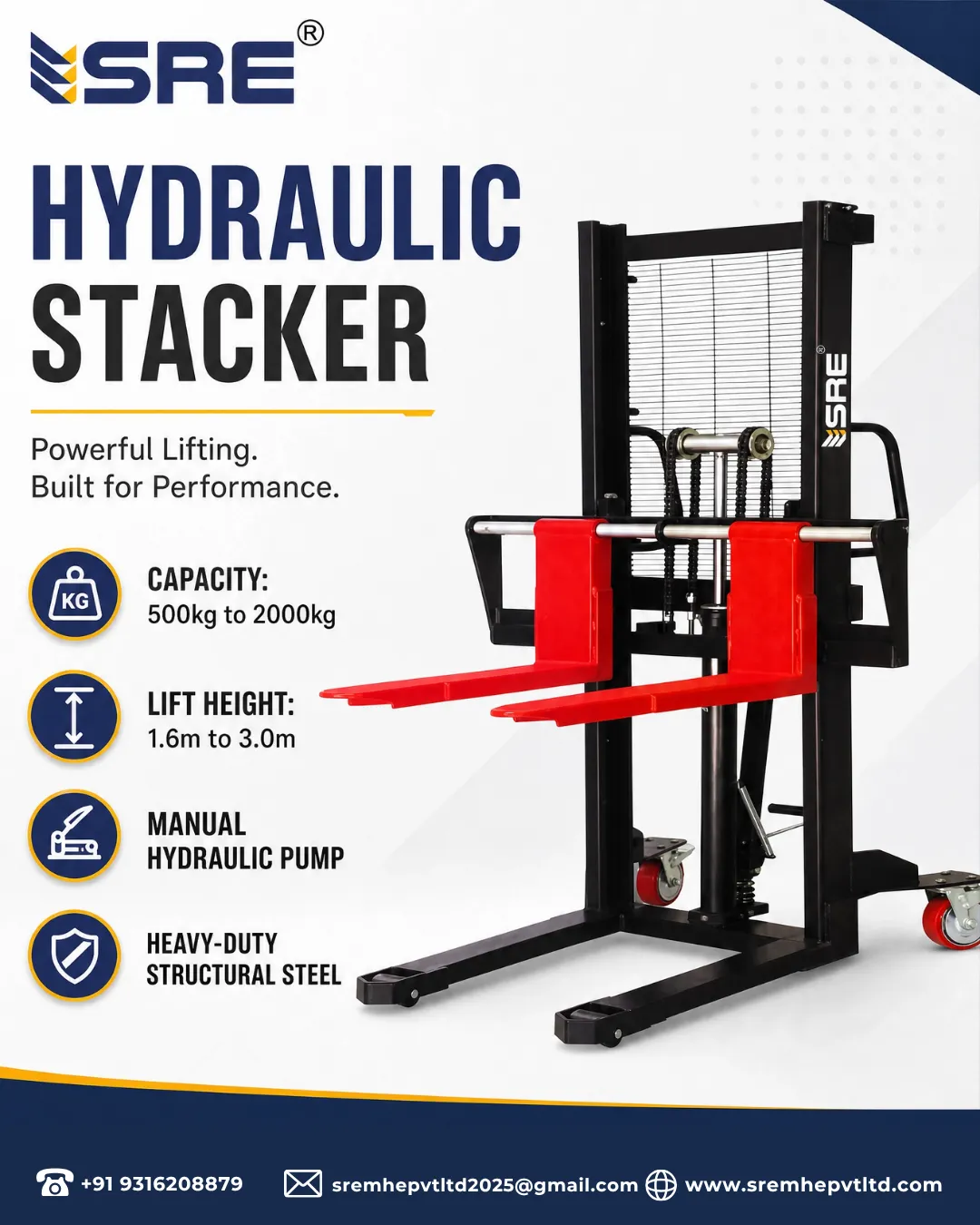
Why Should You Choose Hydraulic Stackers For Smarter Material Handling?
Choose Hydraulic Stackers For Smarter Material Handling to improve warehouse efficiency, reduce manual effort, and ensure safer lifting operations. Hydraulic stackers offer smooth load handling, excellent durability, and cost-effective performance across warehouses, factories, and logistics centers. SRE Material Handling Equipment delivers high-quality hydraulic stackers designed for reliability, productivity, and long-term industrial use, helping businesses optimize workflows while maintaining workplace safety and operational efficiency every day.
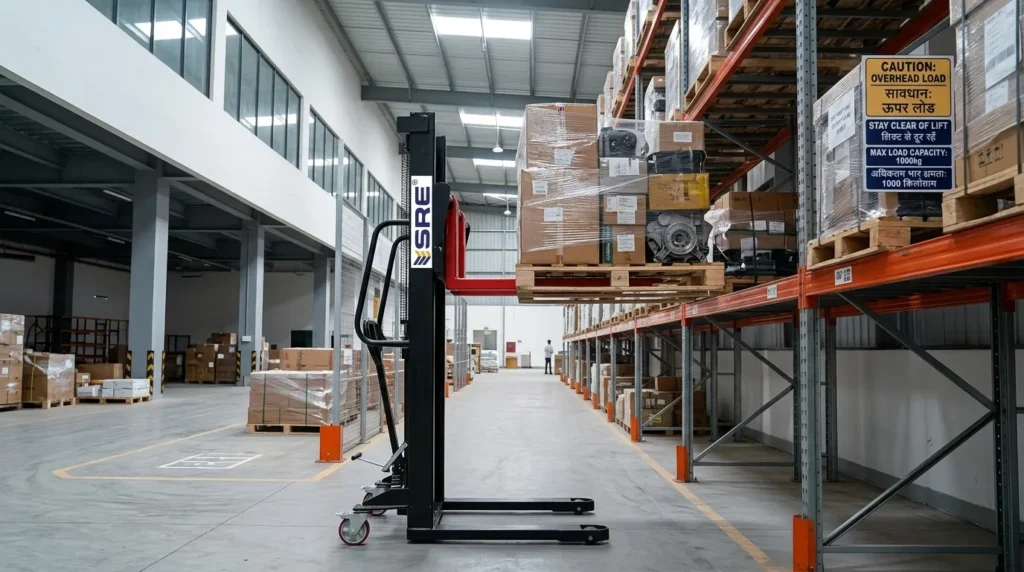
If you have ever watched a warehouse team wrestle a loaded pallet up a half-metre ledge with a manual jack and a lot of hope, you already understand why hydraulic stackers exist. A good hydraulic stacker takes that same task — lifting, stacking, and moving palletised loads in tight aisles — and turns it into a five-minute job that one operator can do safely, repeatedly, and without straining a back or dropping stock. For plant heads and warehouse managers across India who are trying to cut downtime and injury claims at the same time, this single piece of equipment often pays for itself faster than almost anything else on the shop floor.
This article walks through how hydraulic stackers work, what separates a well-built one from a weak one, and how SRE Material Handling Equipment approaches manufacturing, testing, and after-sales support for this category.
Why Choose SRE Material Handling Equipment for Hydraulic Stackers?
The best hydraulic stackers are judged less by their brochure specs and more by how they behave after six months of daily use — does the hydraulic seal still hold pressure, does the mast run true, does the fork carriage stay aligned under repeated loading. SRE Material Handling Equipment, established in 2011 and led by Mr. Gaurang Patel, has built its reputation as one of the trusted material handling equipment manufacturers in Gujarat on exactly that kind of durability testing rather than marketing claims.
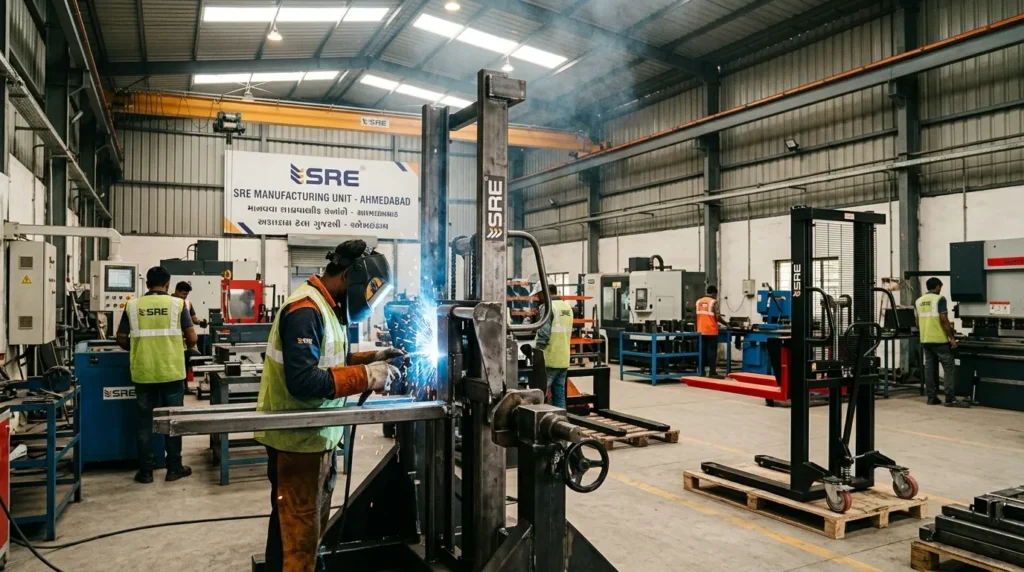
Over the years, the company has delivered more than 15,000 material handling equipment solutions with a 95% client satisfaction rate, and has been recognised with 13 industry awards along the way. That volume matters because it means the hydraulic circuits, mast welds, and load-bearing frames used in these stackers have been refined across thousands of real operating cycles in Indian warehouses — not just lab conditions. Facilities in Ahmedabad, Surat, and Vadodara in particular have leaned on this experience, since Gujarat’s textile, ceramics, and engineering goods sectors move dense, awkward loads that punish poorly built equipment quickly.
Our Hydraulic Stacker Manufacturing Capabilities
Yes, we provide both manually operated and semi-electric hydraulic stackers, built around a straightforward principle: the hydraulic pump should require minimal effort at the handle while the mast delivers stable, controlled lift. SRE’s manufacturing floor in Vastral, Ahmedabad, produces stackers with load capacities generally ranging from 1000 kg to 2000 kg and lift heights up to around 3 to 5 metres, depending on mast configuration (single, double, or triple stage).
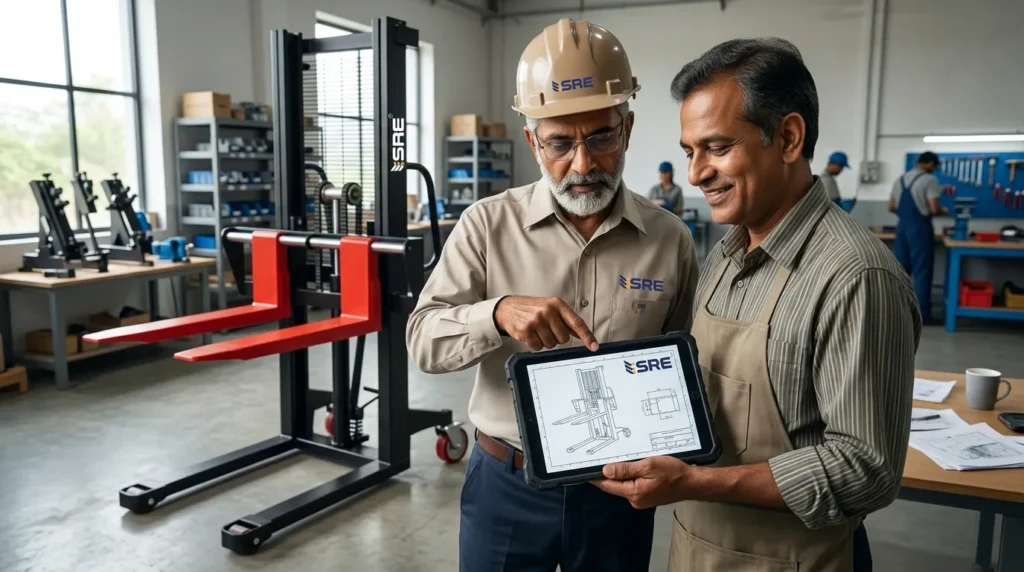
As electric stacker manufacturers and hydraulic stacker specialists, the team also engineers a fair number of custom variants — narrower masts for tight aisle warehouses in Mumbai and Bangalore, higher-capacity versions for auto-parts distributors in Chennai, and corrosion-resistant coatings for a food storage client near Pune who deals with high humidity most of the year. This is really where custom material handling solutions India businesses need most: not a catalogue item, but equipment engineered around the actual pallet dimensions, floor conditions, and load frequency of a specific site.
The broader product range doesn’t stop at stackers. The same engineering team also builds pallet truck manufacturers-grade hand pallet trucks, goods lift manufacturers solutions for multi-storey warehouses, scissor lift manufacturers platforms for maintenance and order-picking work, mobile floor cranes for engine and machinery handling, aerial work platforms, dock levelers for loading bay efficiency, and drum handling equipment for chemical and paint industries. Having all of these under one manufacturing roof means a warehouse in Hyderabad or Jaipur planning a full material flow upgrade can source pallet trucks, an industrial goods lift Ahmedabad unit, and hydraulic stackers from a single supplier instead of coordinating between five vendors.
Navigating Quality Standards & ISO 9001-2015 Certification
Here’s how SRE Material Handling Equipment approaches quality control: every stacker that leaves the facility is checked against documented process controls under the company’s ISO 9001:2015 certification. ISO 9001:2015 is the internationally recognised quality management standard published by the International Organization for Standardization, and it sets requirements around consistent process documentation, defect traceability, and continual improvement — not just a one-time inspection stamp.
In practical shop-floor terms, this means hydraulic cylinder pressure testing, mast alignment checks, and load testing at rated capacity happen as a standard part of the build process, not as an afterthought before dispatch. For a warehouse equipment supplier serving safety-conscious sectors like pharma, food processing, and automotive components, this documentation trail also becomes useful during client audits — several customers in Chandigarh and Kolkata have specifically asked for ISO compliance records as part of their own vendor qualification process, and having that paperwork ready in advance saves weeks of back-and-forth.
Local Manufacturers vs SRE Material Handling Equipment
Choosing between a small local fabricator and an established manufacturer is a genuine trade-off, and it’s worth looking at honestly rather than assuming one is always right.
| Factor | Typical Local Fabricator | SRE Material Handling Equipment |
|---|---|---|
| Experience | Varies widely, often unverified | 10+ years, 15,000+ units delivered |
| Quality certification | Rarely ISO certified | ISO 9001:2015 certified |
| Customisation | Limited engineering support | In-house custom engineering team |
| Load testing before dispatch | Not always documented | Standard documented process |
| After-sales support & spares | Often inconsistent | Dedicated support line |
| Product range | Usually single-category | Stackers, pallet trucks, lifts, cranes, dock levelers |
Small fabricators can work fine for one-off, low-load applications on tight budgets. But for daily multi-shift operations where downtime directly costs money — which describes most warehouses in Indore, Surat, and Ahmedabad that we work with — the documented testing and spares availability tend to matter more over a two- to three-year ownership period than the upfront price difference.
Step-by-Step Process – How We Deliver Hydraulic Stackers
- Site and load assessment – The team reviews pallet dimensions, aisle width, floor type, and typical load weight, either over a call or an on-site visit for larger orders.
- Configuration selection – Based on that assessment, the right mast height, capacity, and fork spread are finalised, with custom options flagged where needed.
- Fabrication and hydraulic assembly – Frame welding, hydraulic cylinder fitting, and mast assembly happen at the Vastral facility under ISO-documented process controls.
- Load and pressure testing – Each unit is tested at rated load before it’s cleared for dispatch.
- Dispatch and installation guidance – Units are shipped with operating instructions, and the team is available by phone for setup questions.
- After-sales support – Ongoing support for spares, maintenance queries, and future capacity upgrades as the business grows.
This process is roughly the same whether the order is a single stacker for a small unit in Jaipur or a batch order for a large logistics park near Delhi.
Real Client Case Study
A mini example first: a packaging materials distributor in Ahmedabad’s Vatva industrial estate switched from manual pallet jacks to two hydraulic stackers in 2023 and reported that loading time per truck dropped by roughly 30%, mainly because one operator could now stack to a second level without waiting for a forklift to be free.
Case Study – Mid-Sized Auto Components Warehouse, Vadodara
A Vadodara-based auto components distributor (name withheld on request) was running a 1,200 sq. m. warehouse with three manual pallet trucks and no vertical stacking capability. Stock was kept single-layer across the floor, which meant the facility was effectively using only about 60% of its available storage height, and staff were reporting recurring lower-back strain from repetitive manual lifting.
After a site assessment, SRE Material Handling Equipment recommended two 1500 kg semi-electric hydraulic stackers with double-mast configuration, sized to the client’s standard pallet footprint and aisle width. Installation and a short operator orientation were completed within a week of dispatch.
Within three months, the client reported that usable storage capacity increased by roughly 35% through two-level stacking, and manual lifting incidents reported to the site supervisor dropped to zero for that quarter. The client has since placed a follow-up order for a goods lift to connect their ground and mezzanine storage levels — a good example of how one equipment upgrade often reveals the next bottleneck in a facility.
Frequently Asked Questions
1. Why should businesses choose hydraulic stackers for smarter material handling?
- Hydraulic stackers improve lifting efficiency, reduce manual labor, enhance workplace safety, and optimize warehouse operations. They are an economical solution for lifting and transporting pallets in warehouses, factories, and logistics centers.
2. What industries benefit most from hydraulic stackers?
- Hydraulic stackers are ideal for warehouses, manufacturing plants, retail distribution centers, pharmaceutical industries, food processing units, engineering workshops, and logistics companies that require safe and efficient material handling.
3. How do hydraulic stackers improve workplace safety?
- Hydraulic stackers minimize manual lifting, reduce employee fatigue, lower the risk of workplace injuries, and provide stable load handling. Their controlled hydraulic lifting mechanism ensures safer operations and better productivity.
4. Hydraulic Stacker lene se warehouse efficiency kaise improve hoti hai?
- Hydraulic stacker heavy pallets ko quickly aur safely lift karta hai, jisse loading, unloading aur stacking ka time kam hota hai. Isse manpower ki requirement reduce hoti hai aur warehouse operations zyada productive ban jaate hain.
5. Kya hydraulic stacker small businesses ke liye bhi suitable hai?
- Haan, hydraulic stackers small aur medium businesses ke liye bhi ek cost-effective solution hain. Ye low maintenance, easy operation aur high durability ke saath daily material handling tasks ko simple aur efficient bana dete hain.
6. SRE Material Handling Equipment ke hydraulic stackers kyun choose karein?
- SRE Material Handling Equipment reliable, heavy-duty aur industrial-grade hydraulic stackers provide karta hai. High-quality construction, smooth performance, excellent lifting capacity aur dependable after-sales support ke saath ye long-term industrial use ke liye perfect choice hain.
7. What capacity and lift height should you choose for a hydraulic stacker?
- The ideal hydraulic stacker depends on your load weight, pallet size, aisle width, and lifting height requirements. Choosing the correct capacity ensures safe operations, higher productivity, and longer equipment life while maximizing warehouse efficiency.