
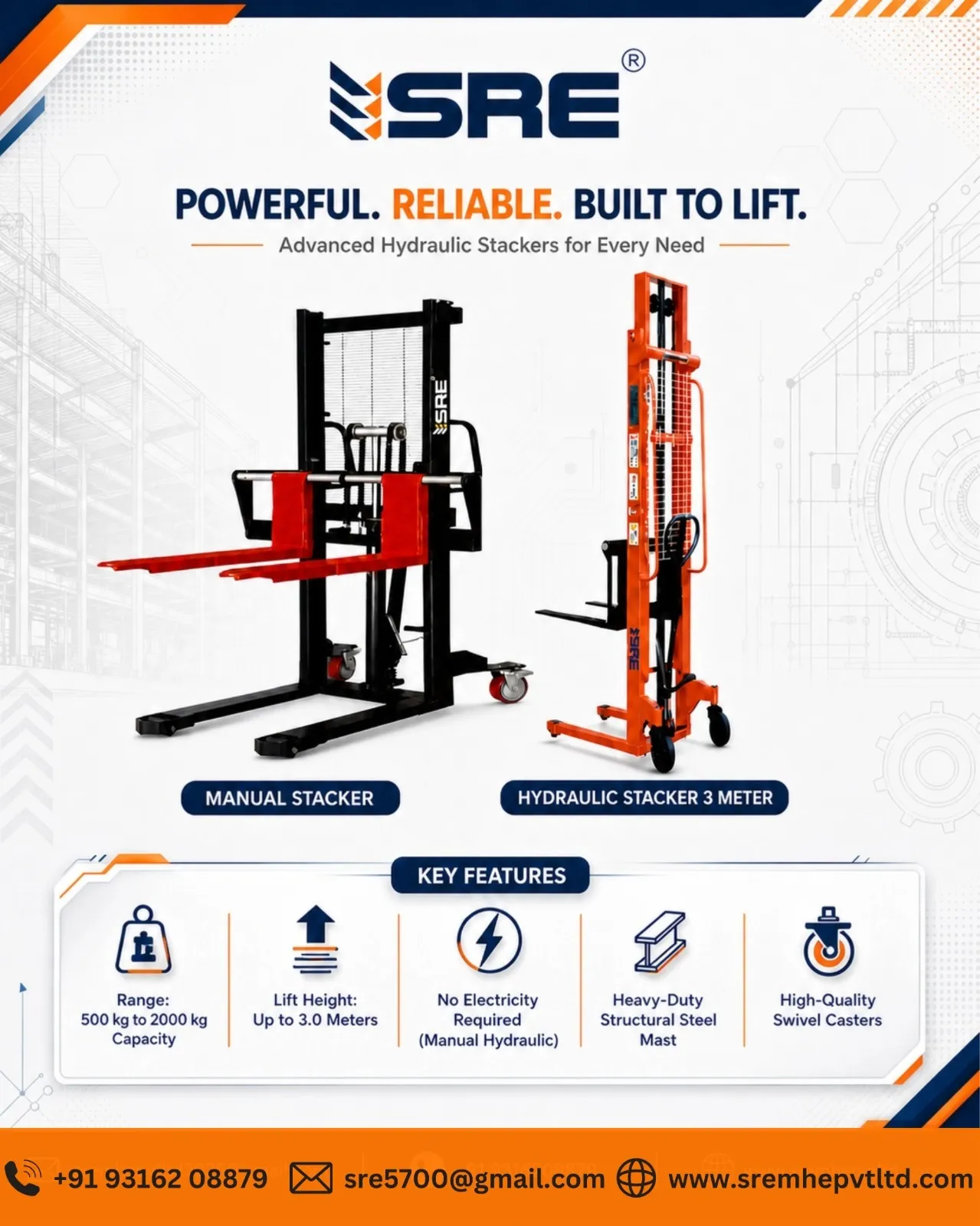
What Is a Manual Hydraulic Stacker and How Does It Work?
A manual hydraulic stacker is a cost-effective material handling solution designed to lift, transport, and stack heavy pallets safely in warehouses and factories. It operates through a hydraulic pump, allowing smooth and controlled lifting without electricity. SRE Pvt Ltd. manufactures durable manual hydraulic stacker models that improve warehouse efficiency, reduce manual effort, and ensure safe load handling across various industrial applications.
How Manual Hydraulic Stackers Improve Warehouse Safety
Ask any warehouse supervisor who has been on the floor for a few years, and they’ll tell you the same thing — most accidents don’t happen because someone was careless. They happen because the equipment wasn’t matched to the task. A worker manually lifting pallets that should have gone onto a stacker, or an outdated hydraulic unit with worn seals leaking under load — these are the everyday risks that add up. After years of working closely with Indian warehouses and factories, I’ve seen how the right hydraulic stacker changes the safety picture on a floor almost immediately. This article looks at how manual hydraulic stackers reduce injury risk, and what to actually check before bringing one into your facility.
Why Choose SRE Material Handling Equipment for How Manual Hydraulic Stackers Improve Warehouse Safety
SRE Material Handling Equipment, formerly known as Shree Ram Enterprise, was founded by Mr. Gaurang Patel and has been building material handling solutions since 2011. Over that time, the company has delivered 15,000+ equipment solutions with a 95% client satisfaction rate, and has been recognised with 13 industry awards along the way. That kind of track record isn’t built overnight — it comes from repeat orders and word-of-mouth trust among warehouse operators who’ve actually used the equipment daily.
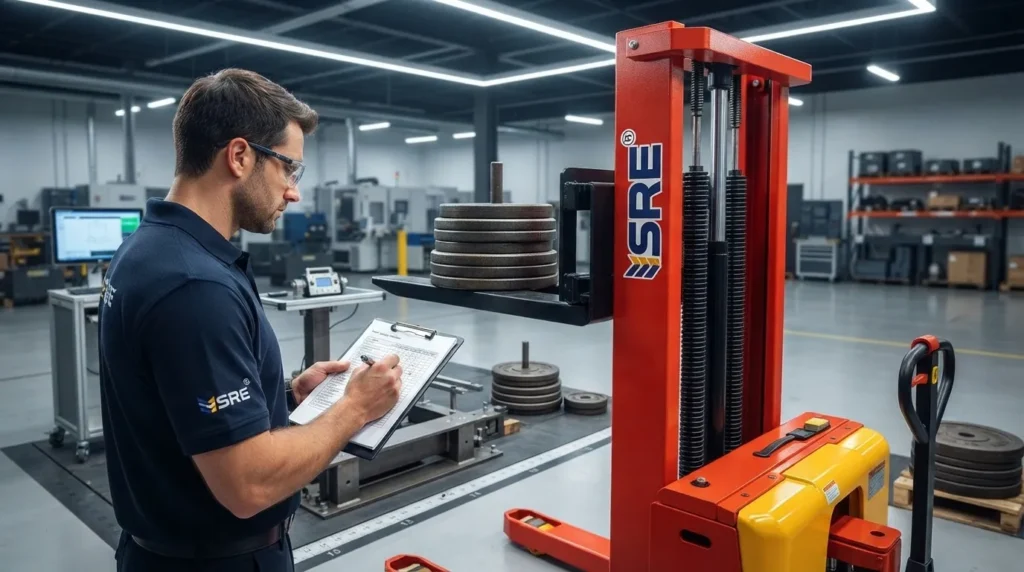
The best way to judge a stacker manufacturer isn’t through brochures, it’s through how the equipment performs after six months of real use. When a logistics facility in Pune or a packaging unit in Vadodara calls back after a year to order three more units of the same model, that tells you something the specification sheet can’t. This is the kind of feedback loop that shapes how material handling equipment manufacturers with genuine field experience design their products.
Our Manual Hydraulic Stacker Manufacturing Capabilities
Here’s how SRE Material Handling Equipment approaches stacker manufacturing: each unit is built around load capacity requirements first, then adjusted for lift height, mast type, and floor conditions specific to the client’s site. The company’s broader manufacturing range includes pallet truck manufacturers-grade hand pallet trucks, electric stacker manufacturers range units, goods lift manufacturers solutions, scissor lift manufacturers platforms, mobile floor cranes, aerial work platforms, dock levelers, and drum handling equipment.
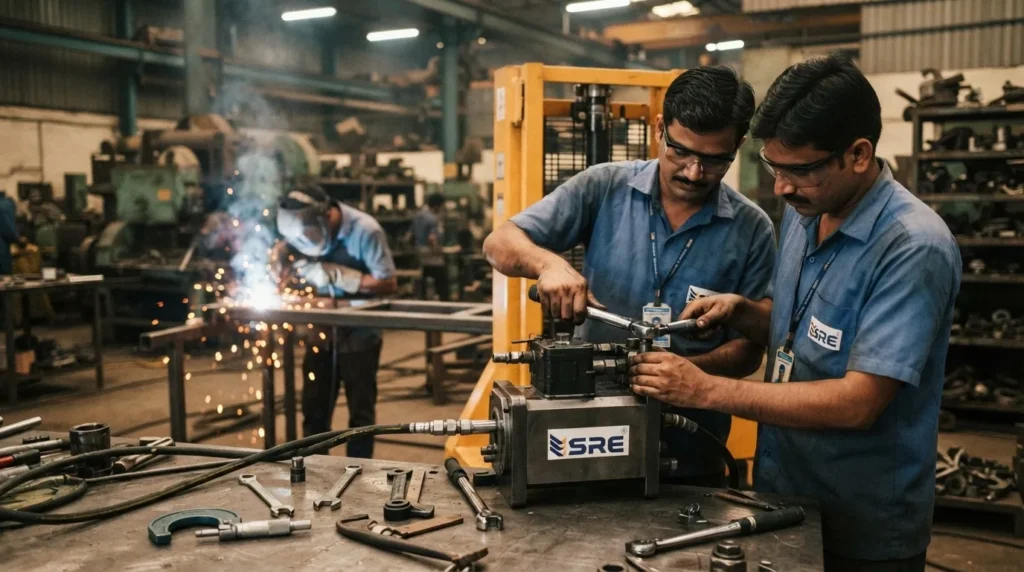
Manual hydraulic stackers specifically are built for facilities that need reliable lifting without the cost and maintenance overhead of a fully electric unit. A Surat textile warehouse handling moderate pallet volumes, for instance, often doesn’t need a battery-powered stacker running two shifts — a well-built manual hydraulic unit with a good pump mechanism does the job safely and at a fraction of the running cost.
Custom material handling solutions India-wide is where things get interesting too. Fork length, mast height, and wheel type all get adjusted depending on whether a Chennai based facility is working with narrow aisles or a Jaipur unit needs extra ground clearance for uneven flooring.
Navigating Quality Standards & ISO 9001-2015 Certification
Yes, we provide ISO 9001-2015 certified equipment, and this matters more than most buyers realise when it comes to safety. ISO 9001-2015 is a globally recognised quality management standard that requires consistent manufacturing processes, documented quality checks, and traceable production records. For a hydraulic stacker, that translates directly into safety — consistent hydraulic seal quality, verified load testing before dispatch, and proper welding standards on the mast assembly.
I’ve walked through warehouses in Kolkata and Chandigarh where older, uncertified stackers had visible weld inconsistencies on the mast—the kind of thing that doesn’t fail immediately but shows up as fatigue cracking after eighteen months of daily use. A certified manufacturing process catches these issues before the unit ever reaches the floor. Industry guidance from the Occupational Safety and Health Administration (OSHA) also emphasizes using properly maintained and inspected material handling equipment to improve workplace safety and reduce operational risks.
Load testing documentation is something procurement teams should always ask for. It’s a simple request, but a surprising number of Indian warehouses skip this step and only realise its importance after a near-miss incident during a safety audit.
Local Manufacturers vs SRE Material Handling Equipment
| Parameter | Typical Local Manufacturer | SRE Material Handling Equipment |
|---|---|---|
| Quality Certification | Often uncertified | ISO 9001-2015 Certified |
| Track Record | Limited history | 15K+ units delivered since 2011 |
| Client Satisfaction Data | Rarely published | 95% client satisfaction rate |
| Industry Recognition | Uncommon | 13 industry awards |
| Customisation Capability | Limited configurations | Custom mast, fork, and wheel options |
| Product Range | Single category focus | Stackers, lifts, cranes, dock levelers, and more |
Step-by-Step Process – How We Deliver Manual Hydraulic Stackers
Here’s how SRE Material Handling Equipment typically handles an order, from a Delhi based warehouse manager’s first enquiry through to installation:
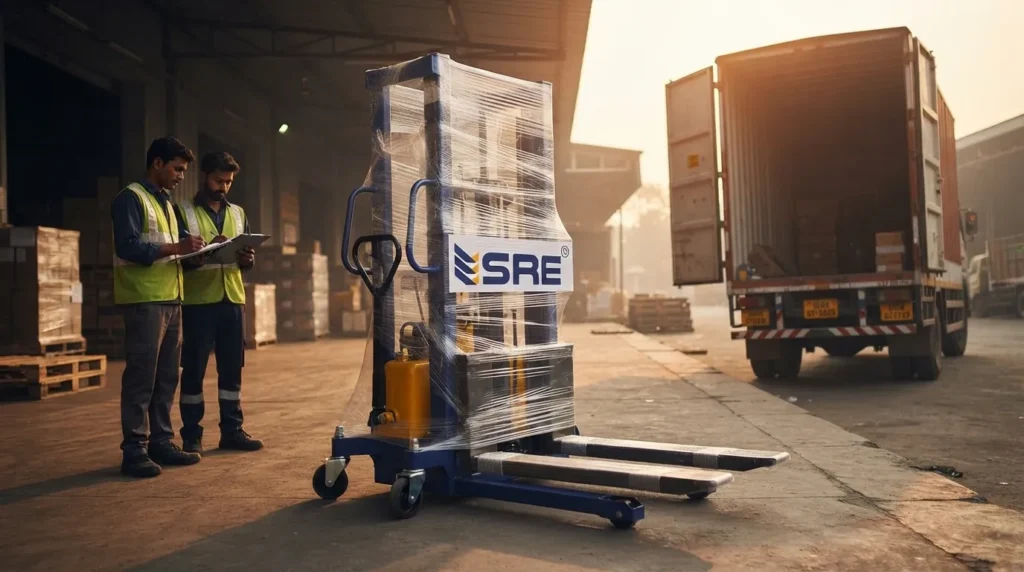
- Site and load assessment — understanding aisle width, floor type, typical pallet weight, and lift height required.
- Configuration selection — choosing fork length, mast height, and wheel type suited to the facility.
- Manufacturing under ISO 9001-2015 process controls — with documented quality checks at each stage.
- Load testing — verifying the unit performs safely at rated capacity before dispatch.
- Delivery and installation guidance — including basic operator orientation on safe usage.
- After-sales support — for maintenance, spare parts, and service queries as the unit ages.
This process stays consistent whether the order comes from a single-unit enquiry from a small Indore workshop or a multi-unit order from a larger Bangalore logistics park.
Real Client Case Study
A mid-sized FMCG distribution warehouse near Ahmedabad, referred to here as “Client B” for confidentiality, was relying on manual pallet lifting by workers for stock that should have been mechanically handled. This led to recurring minor strain injuries and slower dispatch times during peak season.
SRE Material Handling Equipment assessed their floor layout and pallet weights, then supplied a set of manual hydraulic stackers configured for their aisle width and typical load range. Within a few months, the warehouse reported a noticeable drop in strain-related incidents and faster pallet movement during dispatch cycles, since workers were no longer manually lifting loads that the stackers could now handle safely.
A comparable situation played out with a Mumbai based cold storage facility, where introducing properly rated stackers reduced the reliance on ad-hoc manual handling that had previously caused product damage as well as safety concerns.
FAQs
Q1. Manual hydraulic stacker kis kaam aata hai?
- Manual hydraulic stacker warehouses aur factories mein heavy pallets ko safely lift, move, aur stack karne ke liye use hota hai. Yeh material handling ko fast, safe, aur efficient banata hai.
Q2. Kya manual hydraulic stacker small warehouse ke liye sahi hai?
- Haan, manual hydraulic stacker small aur medium warehouses ke liye ek cost-effective solution hai. Isse heavy loads ko bina electricity ke easily handle kiya ja sakta hai.
Q3. Manual hydraulic stacker kitna weight utha sakta hai?
- Capacity model par depend karti hai. Most manual hydraulic stacker 500 kg se lekar 2000 kg tak ke loads ko safely lift aur stack kar sakte hain.
Q4. Manual hydraulic stacker aur forklift mein kya difference hai?
- Manual hydraulic stacker manually operate hota hai aur compact spaces ke liye best hai. Forklift battery ya fuel se chalta hai aur larger warehouses mein heavy-duty operations ke liye use hota hai.
Q5. Manual hydraulic stacker ki maintenance kaise kare?
- Regular hydraulic oil check kare, wheels aur brakes inspect kare, aur moving parts ko clean aur lubricate rakhe. Isse manual hydraulic stacker ki performance aur lifespan improve hoti hai.
Q6. Best quality manual hydraulic stacker kahan se kharide?
- Trusted manufacturers jaise SRE se manual hydraulic stacker kharidna ek achha option hai, kyunki yahan durable quality, reliable performance, aur after-sales support milta hai.
For a detailed cost breakdown or site assessment, you can request a Free Equipment Consultation, or Download our Material Handling Cost Guide. Reach the SRE Material Handling Equipment team at +91 9316 208879 (WhatsApp available) or email sremhepvtltd2025@gmail.com. The facility is located at Ground Floor, A-12, Pushp Business Campus, Ring Road Circle, Vastral, Ahmedabad – 382418, Gujarat.